← Faith & Worship Guide

Faith & Worship · An illustrated history

Through the centuries

The Christian Church through time, with a closer look at Catholic and Anglican history in England.

Follow the thread from the first Christian communities to the Catholic and Anglican churches in England. The medieval inheritance is shared; the Reformation brings separate paths, lasting disagreements and new forms of worship. Manuscripts, mosaics, portraits, embroidery and archive photographs bring the changes into view.

Before the Reformation, the English Church belonged to the western Church in communion with Rome. Modern denominational labels should not be projected backwards unchanged. In Anglican usage, “catholic” can also mean the universal Church or its historic inheritance, not necessarily Roman Catholic.

Follow the timeline down the page Follow the illustrated history down the main column. The smaller portraits and musical notes on the right introduce composers and singing traditions from the intervening years: select one to open a précis, listen to a musical example and explore further. Life dates appear beneath a composer’s name; the smaller date above marks the musical moment discussed.

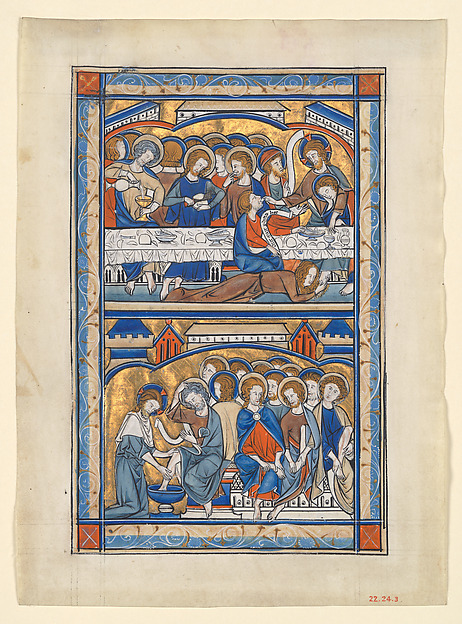
  1. The first communitiesMedieval manuscript scenes of the Last Supper and the washing of the disciples’ feet.c.30–100

    A new faith takes root

    From Jesus’ followers to communities across the Mediterranean.

    Explore this moment
  2. Empire & beliefByzantine mosaic portrait of Emperor Constantine holding a model of a city.325

    The Council of Nicaea

    Bishops gather; the language of the Creed takes shape.

    Explore this moment
  3. Shared roots · Roman BritainCentral roundel from the Roman mosaic found at Hinton St Mary in Dorset.4th century

    Christianity before Augustine

    Roman Britain already has Christian communities.

    Explore this moment
  4. Early councils · Christian beliefNinth-century manuscript miniature showing the First Council of Constantinople381

    Constantinople develops the language of the Creed

    The Church’s confession gives fuller expression to belief in the Holy Spirit.

    Explore this moment
  5. Early councils · The identity of ChristVasily Surikov’s nineteenth-century painting of the Council of Chalcedon451

    Chalcedon defines Christ as divine and human

    Careful theological language brings agreement for some and division for others.

    Explore this moment
  6. Monastic life · Western ChristianityFra Angelico’s depiction of Saint Benedict and Saint Peter Martyr6th century

    Benedict gives prayer a daily rhythm

    A rule of life orders worship, work and community.

    Explore this moment
  7. Eastern Christianity · ConstantinopleByzantine mosaic in Hagia Sophia, depicting Mary and Christ between emperors537

    Justinian’s Hagia Sophia is dedicated

    Architecture, imperial ambition and worship meet beneath a great dome.

    Explore this moment
  8. Mission & manuscriptsSaint Luke seated in an architectural frame in the sixth-century Augustine Gospels.597

    Augustine arrives in Kent

    A mission from Rome meets an existing Christian landscape.

    Explore this moment
  9. Shared roots · Anglo-Saxon EnglandWilliam Richardson’s nineteenth-century watercolour view of the ruins of Whitby Abbey.664

    Hild’s monastery hosts the Synod of Whitby

    Different customs meet over the date of Easter.

    Explore this moment
  10. Empire & worship · Western EuropeAlbrecht Dürer’s later imagined portrait of Charlemagne800

    Charlemagne is crowned emperor

    Papal authority and a Frankish ruler reshape western Christendom.

    Explore this moment
  11. Medieval reform · BurgundyMedieval manuscript scenes of the Last Supper and the washing of the disciples’ feet.910

    Cluny becomes a centre of monastic reform

    A new foundation develops an influential network of religious houses.

    Explore this moment
  12. East & WestByzantine mosaic at Hagia Sophia: Mary and the Christ child between Justinian and Constantine.1054

    A widening divide

    Rome and Constantinople: a landmark in a much longer separation.

    Explore this moment
  13. Church & conquestBishop Odo blesses food and drink in an embroidered scene from the Bayeux Tapestry.1066

    Faith in a Norman world

    The Bayeux Tapestry places a bishop at the heart of the story.

    Explore this moment
  14. Medieval reform · Cistercian lifeKing David surrounded by musicians in the Stephen Harding Bible1098

    Cîteaux seeks a renewed simplicity

    A reform of Benedictine life becomes a new European monastic movement.

    Explore this moment
  15. Crown & ChurchMedieval manuscript depiction of knights attacking Thomas Becket.1170

    Becket is killed at Canterbury

    A royal friendship becomes a struggle over power.

    Explore this moment
  16. Shared heritage · Medieval EnglandMedieval manuscript scenes of the Last Supper and the washing of the disciples’ feet.c.1200–1500

    Parishes, monasteries and daily prayer

    The Church shapes the rhythms of ordinary life.

    Explore this moment
  17. Medieval Church · RomeMatthew Paris’s manuscript illustration of the Fourth Lateran Council1215

    The Fourth Lateran Council regulates Christian life

    Belief, pastoral care and the obligations of parish life come into focus.

    Explore this moment
  18. Medieval crisis · Papal authorityA medieval illustration of Martin V’s coronation at Constance1378–1417

    Rival papal claimants divide the western Church

    The Western Schism turns a dispute over legitimacy into a European crisis.

    Explore this moment
  19. Eastern Christianity · ConstantinopleByzantine mosaic in Hagia Sophia, depicting Mary and Christ between emperors1453

    Constantinople falls to the Ottomans

    The Byzantine Empire ends; Orthodox Christian life continues.

    Explore this moment
  20. European Reformation · WittenbergLucas Cranach’s portrait of Martin Luther1517

    Luther challenges the sale of indulgences

    An academic dispute develops into a far-reaching religious rupture.

    Explore this moment
  21. Reformation · AuthorityHans Holbein the Younger’s portrait of Henry VIII, wearing a richly decorated cap and coat.1534

    Henry VIII breaks with papal authority

    The Act of Supremacy changes who governs the Church.

    Explore this moment
  22. Reformation · Monastic lifeWilliam Richardson’s nineteenth-century watercolour view of the ruins of Whitby Abbey.1536–1540

    The monasteries are dissolved

    Religious communities close; buildings and lands change hands.

    Explore this moment
  23. Catholic reform · TrentHistorical painting of bishops assembled at the Council of Trent1545–1563

    The Council of Trent defines a Catholic response

    Doctrine and reform shape the Catholic Church for generations.

    Explore this moment
  24. Reformation & worshipDecorated black-letter title page of the 1549 Book of Common Prayer.1549

    An English prayer book

    New words and old prayers reshape the sound of worship.

    Explore this moment
  25. English Reformation · Prayer Book revisionGerlach Flicke’s portrait of Archbishop Thomas Cranmer1552

    A second Prayer Book changes the Communion service

    The 1549 settlement is revised in a more explicitly Reformed direction.

    Explore this moment
  26. Roman Catholic restorationMary I seated in Antonis Mor’s portrait, holding a red rose.1553–1558

    Mary I restores communion with Rome

    The religious direction changes again.

    Explore this moment
  27. Church of England · SettlementThe Darnley portrait of Elizabeth I, in an elaborate dress and jewellery.1559

    Elizabeth’s religious settlement

    Royal supremacy and an English prayer book return.

    Explore this moment
  28. Elizabethan settlement · DoctrineSixteenth-century portrait of Archbishop Matthew Parker1563–1571

    The Thirty-Nine Articles give the settlement a doctrinal voice

    Belief, Scripture, sacraments and church order are set out in a lasting formulary.

    Explore this moment
  29. Music & conscienceLater engraved portrait of the composer William Byrd.1572

    Byrd joins the Chapel Royal

    A Catholic composer serves a Protestant queen.

    Explore this moment
  30. England · Religion, loyalty and violenceEngraved portraits of the Gunpowder Plot conspirators1605

    The Gunpowder Plot deepens anti-Catholic suspicion

    A failed attack on king and Parliament brings consequences far beyond the conspirators.

    Explore this moment
  31. Church of England · ScriptureDecorated title page of the King James Bible of 16111611

    The King James Bible is published

    A new English translation acquires an enduring voice in worship.

    Explore this moment
  32. Church of England · Conflict & restorationThe title page of John Baskerville’s 1762 printing of the 1662 Book of Common Prayer.1640s–1662

    A prayer book returns after civil war

    The 1662 settlement preserves a tradition and excludes others.

    Explore this moment
  33. Religion & civil rights · EnglandEngraved portraits of William III and Mary II1689

    The Toleration Act permits some dissenting worship

    Licensed Protestant meeting houses gain a more secure place.

    Explore this moment
  34. Evangelical revival · BritainGeorge Romney’s portrait of John Wesley1739

    Methodist preaching moves beyond the church walls

    Open-air preaching and organised societies give revival a lasting form.

    Explore this moment
  35. Catholic life · Religious libertyThomas Gainsborough’s portrait of William Pitt the Younger1791

    Catholic relief widens freedom of worship

    A further step loosens the restrictions on Catholic religious life.

    Explore this moment
  36. Roman Catholic life · Civil rightsAn 1847 portrait print of Daniel O’Connell.1829

    Catholic emancipation

    Long-standing barriers to public office are removed.

    Explore this moment
  37. Anglican renewal · Oxford MovementJohn Henry Newman as a cardinal, painted by John Everett Millais.1833 onwards

    Recovering the Church’s catholic inheritance

    Keble, Newman and Pusey ask what the Church of England is.

    Explore this moment
  38. Roman Catholic Church · New diocesesNineteenth-century portrait of Cardinal Nicholas Wiseman seated in an armchair.1850

    The Catholic hierarchy is restored

    Wiseman becomes the first Archbishop of Westminster.

    Explore this moment
  39. Roman Catholic Church · AuthorityNineteenth-century engraving of the First Vatican Council1869–1870

    The First Vatican Council defines papal infallibility

    A council clarifies a contested understanding of papal teaching authority.

    Explore this moment
  40. Anglican worship · CornwallNineteenth-century portrait of Edward White Benson1880

    Truro brings nine lessons together with carols

    Bishop Benson’s Christmas service precedes the better-known King’s tradition.

    Explore this moment
  41. Roman Catholic worship · Sacred musicHistorical photograph of Pope Pius X1903

    Pius X sets out a programme for sacred music

    Gregorian chant, polyphony and liturgical purpose receive renewed emphasis.

    Explore this moment
  42. Anglican worship · CambridgeDavid Loggan’s engraved view inside King’s College Chapel1918

    Nine Lessons and Carols begins at King’s

    After the First World War, readings and carols offer a fresh approach to worship.

    Explore this moment
  43. A worldwide ChurchBlack-and-white archival photograph of the World Council of Churches assembly in Amsterdam’s Nieuwe Kerk.1948

    Churches meet in Amsterdam

    Cooperation and the search for unity after war.

    Explore this moment
  44. Church of England · Coronation and broadcastingElizabeth II on the palace balcony after her coronation in 19531953

    An ancient coronation liturgy reaches television audiences

    Elizabeth II’s coronation brings historic worship and new music before a vast audience.

    Explore this moment
  45. Catholic & Anglican · Renewal & dialogueArchival portrait photograph of Archbishop Michael Ramsey.1962–1966

    A council, a meeting and a new conversation

    Vatican II and the meeting of Paul VI with Michael Ramsey.

    Explore this moment
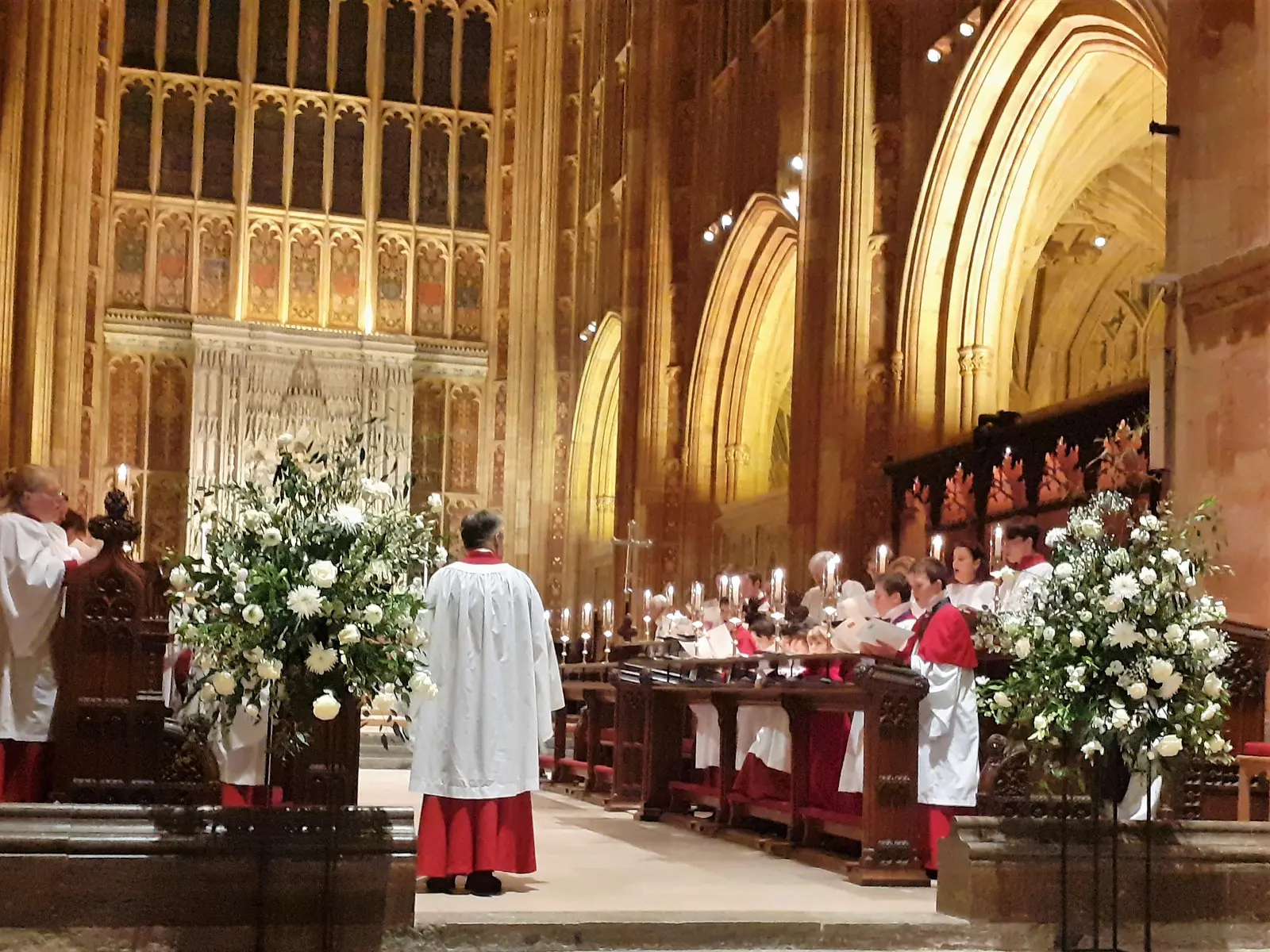
  46. Church of England · Contemporary liturgyA choir singing in Sherborne Abbey2000

    Common Worship brings new resources into parish life

    Contemporary and traditional language sit within a wider family of authorised services.

    Explore this moment
  47. Christian worship · Pandemic disruptionA May 2020 notice announcing the suspension of Mass during the pandemic2020

    Churches find ways to worship while apart

    Restrictions on gathering prompt streamed services and new forms of musical sharing.

    Explore this moment

Church-history milestones form the main thread; composer portraits and musical notes sit beside the relevant interval in the chronology. Dates are not spaced proportionally. The musical moment above a composer’s name is separate from the life dates beneath it. The dates belong to events; many illustrations were made later. Every historical milestone and musical précis includes an expandable listening example. The accompanying note explains whether it belongs to the period or is a later musical connection. Each expanded account gives the image’s date and source.

Explore the milestones and musical précis

c.30–100 · A new faith takes root
Medieval manuscript scenes of the Last Supper and the washing of the disciples’ feet.
Last Supper and Washing of the Apostles’ Feet, British manuscript leaf, c.1250–70. A later depiction of Gospel events. Metropolitan Museum of Art, 22.24.3; public domain. Image source & larger view.

The story begins without a cathedral, a choir school or a prayer book. Jesus’ first followers were Jews, and the movement that grew around his life, death and resurrection had to work out who belonged and how they should live. Paul’s letters bring us close to the arguments: these were real communities, not a row of perfectly behaved saints.

Peter and Paul became towering figures in Christian memory. Yet the history of the Church is not simply a procession of leaders. It is also the history of households, journeys, shared meals and people who carried the message into another language.

Listen for the connection: when a reading begins with a letter to a church, imagine a message arriving for a community rather than a chapter in a textbook. Background: Christianity’s beginnings.

Listen to an example

Oxyrhynchus Hymn — modern choral arrangement

Louisville Women’s Choir · arrangement by Johann Kim · Sylvia Kim, flute

A modern arrangement of a Greek Christian hymn fragment from late-third- or early-fourth-century Egypt. This surviving witness comes after the first Christian communities; it is not first-century music.
Explore early and medieval sacred music →

Read about this musical connection.

325 · The Council of Nicaea
Byzantine mosaic portrait of Emperor Constantine holding a model of a city.
Constantine I, detail of the later southwestern entrance mosaic, Hagia Sophia. This is not a picture of the council. Photograph: Myrabella, CC0; artwork public domain. Image source & larger view.

An emperor wants agreement; bishops arrive with convictions they will not easily surrender. In 325, Constantine called the Council of Nicaea to address disputes about Christian belief, especially the identity of Christ. The relationship between imperial power and the Church was entering a new chapter.

The questions were not merely verbal niceties. What Christians said about Jesus shaped how they prayed to him. But do not imagine the entire Creed used today being settled in a single sitting: its wording developed further after Nicaea.

In the stalls: the Creed carries the traces of those arguments. Its carefully chosen words have a history as well as a melody. The Creed in worship · Nicaea explained.

Listen to an example

Credo — Palestrina

The Tallis Scholars

Palestrina’s Renaissance setting shows how the Creed became music many centuries after Nicaea. Its text reflects the Creed’s later development; this is not music from the council of 325.

Explore the Creed in the Eucharist guide →

4th century · Christianity before Augustine
Central roundel from the Roman mosaic found at Hinton St Mary in Dorset.
Hinton St Mary mosaic, 4th century; central figure traditionally identified as Christ. Photograph: Udimu, CC BY-SA 2.0, via Wikimedia Commons. Unaltered image. Image source & larger view.

Christianity was present in Britain centuries before Augustine arrived in Kent. Surviving objects and buildings give glimpses of belief during Roman rule; the Hinton St Mary mosaic is a particularly striking example from Dorset. Its central figure is traditionally identified as Christ, with the Chi-Rho symbol behind the head.

It would be misleading to call these people either modern Anglicans or members of today’s English Roman Catholic institutions. Both later traditions look back to a Christian past older than their Reformation divisions.

Look closely: the Greek letters chi and rho begin the name Christ. Christianity before the mission of 597.

Listen to an example

Oxyrhynchus Hymn — modern choral arrangement

Louisville Women’s Choir · arrangement by Johann Kim · Sylvia Kim, flute

A comparison from the wider early Christian world: the surviving hymn fragment is from Egypt, not Roman Britain. The choral arrangement heard here is modern.

Explore early and medieval sacred music →

Read about this musical connection.

381 · Constantinople develops the language of the Creed
Ninth-century manuscript miniature showing the First Council of Constantinople
First Council of Constantinople, Byzantine manuscript miniature, BnF grec 510, 9th century. A later depiction of the council of 381. Public domain. Image source & larger view.

The council held at Constantinople in 381 became a defining point in the history of the Creed. The confession associated with it, later received at Chalcedon, expanded the Church’s shared language about the Holy Spirit.

When a choir sings the Credo, it gives voice to arguments and agreements that developed over generations. The story does not stop in 381: later western additions to the text became a further point of disagreement between churches.

The Vatican: the council’s enduring inheritance.

Listen to an example

Credo — Palestrina

The Tallis Scholars

A Renaissance setting of the western Latin Creed. Listen for words inherited from the early councils, while remembering that both the music and some western textual developments came later.

Explore the Creed in the Eucharist guide →

381 onwards · The words of the Credo

Music in its historical setting · Belief becomes a sung text

The Creed sung at a Eucharist carries the inheritance of the early councils. Its clauses do different work: confession of belief, the story of Christ and the proclamation of the Holy Spirit.

Musical settings belong to many later centuries. The date here concerns the development of the text, not the composition of a surviving melody. Compare where a composer gives particular weight to a phrase.

Listen to an example

Credo — Palestrina

The Tallis Scholars

A Renaissance setting of the Creed: a later musical response to the ancient text.

Explore the Creed in the Eucharist guide →

Historical reference: The council of 381 and its Creed.

451 · Chalcedon defines Christ as divine and human
Vasily Surikov’s nineteenth-century painting of the Council of Chalcedon
Vasily Surikov, Fourth Ecumenical Council of Chalcedon, 1876. Painted more than fourteen centuries after the event. Public domain. Image source & larger view.

The Council of Chalcedon confessed one Christ in two natures, divine and human. Its definition sought to safeguard both the fullness of Christ’s divinity and the reality of his humanity.

The settlement was not accepted by all Christians. The Oriental Orthodox churches preserve a different history of reception, and later dialogue has worked to clarify disagreements. The council helps explain why the early Church cannot be reduced to a simple line leading only to Rome or Canterbury.

Read Chalcedon’s definition and proceedings.

Listen to an example

O magnum mysterium — Victoria

The Sixteen

Victoria’s Renaissance Christmas motet contemplates the mystery of the Incarnation. It is a later musical connection to belief about Christ, rather than a setting of Chalcedon’s definition.

Explore Tomás Luis de Victoria in the Music Library →

451 onwards · Singing the Incarnation

Music in its historical setting · A theme across the centuries

Questions about Christ’s divinity and humanity are heard again in Christmas readings, hymns and motets. A theological formula and a devotional text do different things, but can address the same mystery.

Victoria’s O magnum mysterium is a much later musical example, written in the Renaissance rather than at Chalcedon. Its place in the library offers a way to hear how that theme continued to inspire composers.

Listen to an example

O magnum mysterium — Victoria

The Sixteen

A later, Renaissance example of music contemplating the Incarnation.

Hear a later example in Victoria →

Historical reference: The Council of Chalcedon.

6th century · Benedict gives prayer a daily rhythm
Fra Angelico’s depiction of Saint Benedict and Saint Peter Martyr
Fra Angelico, saints from the Perugia Altarpiece, 15th century. A later devotional depiction, not a contemporary portrait of Benedict. Public domain. Image source & larger view.

Benedict’s Rule, written in the sixth century, sets out a pattern for a community living under an abbot. Prayer is woven through the day and night, alongside work, reading, hospitality and the demands of life together.

Its chapters on the divine office assign psalms and readings to particular hours. The Rule gradually became a major influence on western monastic life. England’s later monasteries, and the offices from which Anglican Morning and Evening Prayer developed, belong within that longer inheritance.

Read the Rule’s chapters on prayer.

Listen to an example

Te Deum — Gregorian chant

Monks of the Solesmes Congregation

The unison singing offers an introduction to the continuing monastic chant tradition. This modern recording does not reconstruct the precise melodies used in Benedict’s sixth-century community.

Explore early and medieval sacred music →

6th century · The sung offices

Music in its historical setting · Psalms through the day

Benedict’s Rule arranges psalms across the hours of prayer and across the week. Singing here is part of a repeated communal discipline: a text returns, a season changes and the community gathers again.

The later offices of Vespers and Compline help explain the inheritance behind Anglican evening worship. Follow that relationship through the guide to Evensong.

Listen to an example

Ubi caritas — Gregorian chant

Monks of Solesmes

A modern recording of the plainchant tradition; this Holy Thursday chant illustrates its unison sound, rather than reconstructing an office at this date.

Explore the history of Evensong →

Historical reference: The Rule of Benedict, chapters 16–17.

537 · Justinian’s Hagia Sophia is dedicated
Byzantine mosaic in Hagia Sophia, depicting Mary and Christ between emperors
Southwestern entrance mosaic, Hagia Sophia: Mary and Christ between Justinian and Constantine. A later Byzantine work, made centuries after the dedication of 537. Photograph: Myrabella, CC0; artwork public domain. Image source & larger view

The church built under Emperor Justinian between 532 and 537 became the great cathedral of Constantinople. Its scale and luminous interior expressed the ambitions of a Christian empire as well as the demands of worship.

A building also shapes what singing feels like. Long resonance can join successive notes into a continuous sound, while a large space changes how singers and worshippers hear words. The surviving mosaics and later views belong to different stages of the building’s history.

The Metropolitan Museum: the building of Hagia Sophia.

Listen to an example

Cherubic Hymn in Mode 1

Cappella Romana · Icons of Sound

Cappella Romana performs medieval Byzantine chant with simulated Hagia Sophia acoustics. The example explores sound and space; it does not reconstruct the dedication service of 537.

Explore the eastern chant tradition →

6th century onwards · Chant in a resonant space

Music in its historical setting · Music, architecture and listening

Large church interiors change the experience of sung prayer. Resonance can prolong a vowel and connect successive notes; it also asks singers to think carefully about pace and clarity.

Hagia Sophia’s musical life developed over many centuries. Modern performances and acoustic reconstructions should not be mistaken for recordings of sixth-century worship.

Listen to an example

Cherubic Hymn in Mode 1

Cappella Romana · Icons of Sound

A modern performance of medieval Byzantine chant with a simulation of Hagia Sophia’s acoustics; not a recording or reconstruction of its sixth-century dedication.

Explore the eastern chant tradition →

Historical reference: Hagia Sophia’s architecture and history.

597 · Augustine arrives in Kent
Saint Luke seated in an architectural frame in the sixth-century Augustine Gospels.
St Luke, Augustine Gospels, 6th century. Corpus Christi College, Cambridge, MS 286, fol.129v. Not a portrait of Augustine. Public domain via Wikimedia Commons. Image source & larger view.

Pope Gregory the Great sent Augustine and a company of monks to Kent. Their arrival in 597 became a decisive moment in Canterbury’s history. Yet this was not the first appearance of Christianity in Britain: the story was already under way, and Kent’s Queen Bertha was herself a Christian.

Here the Church’s history becomes a web of relationships: pope and missionary, queen and king, local custom and Roman connection. A mission described in a few lines could change the direction of institutions for centuries.

A useful distinction: Augustine of Canterbury is not Augustine of Hippo, the earlier North African bishop and writer. Familiar saintly names can hide very different lives. Meet Augustine at Canterbury.

Listen to an example

Ubi caritas — Gregorian chant

Monks of Solesmes

A modern performance of the western plainchant tradition associated with Gregory’s name. Gregorian chant developed through a longer history; this is not a melody documented as sung by Augustine’s party in 597.

Explore medieval sacred music →

664 · Hild’s monastery hosts the Synod of Whitby
William Richardson’s nineteenth-century watercolour view of the ruins of Whitby Abbey.
Whitby Abbey, 19th-century watercolour by William Richardson. The later medieval ruins are not the buildings where the synod met in 664. Public domain via Wikimedia Commons. Image source & larger view.

At the monastery governed by Abbess Hild, King Oswiu heard arguments about competing Christian customs, especially how to calculate Easter. He chose the Roman practice. The decision helped bring Northumbrian observance into closer alignment with Rome.

This was not a contest between Roman Catholics and Anglicans: that later division did not yet exist. Nor were the Irish-influenced and Roman traditions two wholly separate religions. Hild’s leadership also reminds us that women held important places in the early English Church.

In worship: the calendar itself has a history of discussion and decision. English Heritage explains the synod.

Listen to an example

Cædmon’s Hymn — a modern musical reimagining

Stef Conner

Bede associates Cædmon’s song with Hild’s community at Whitby. The Old English text survives, but its original melody does not: this modern reimagining connects with the monastery’s musical story, not the proceedings of the synod.

Explore early and medieval sacred music →

Read about this musical connection.

800 · Charlemagne is crowned emperor
Albrecht Dürer’s later imagined portrait of Charlemagne
Albrecht Dürer, Charlemagne, c.1511–13. Painted centuries after his coronation; Germanisches Nationalmuseum, Nuremberg. Public domain. Image source & larger view.

On Christmas Day 800, Pope Leo III crowned Charlemagne emperor in Rome. The ceremony brought papacy and Frankish kingship into a powerful, sometimes uneasy relationship. It also expressed a western claim to the inheritance of Christian Roman empire.

The Carolingian world promoted learning, the copying of books and greater consistency in worship. These ambitions helped carry texts and musical practices across regions. Charlemagne did not invent Gregorian chant, but his age is an important setting for its transmission.

The Metropolitan Museum: Carolingian art and empire.

Listen to an example

Te Deum — Gregorian chant

Monks of the Solesmes Congregation

A hymn of praise heard here in the western chant tradition. It helps introduce the liturgical inheritance transmitted through medieval books, without claiming to reproduce Charlemagne’s coronation music.

Explore early and medieval sacred music →

8th–9th centuries · Gregorian chant

Music in its historical setting · Roman and Frankish traditions

The Frankish adoption of Roman worship brought singers and repertories across the Alps. Chant developed through transmission and exchange, including the meeting of Roman and Gallican practices.

The label “Gregorian” connects the repertory with Pope Gregory the Great, but it does not make him the composer of every melody. Listen for a single melodic line shaped by the Latin text.

Listen to an example

Ubi caritas — Gregorian chant

Monks of Solesmes

A modern recording of the plainchant tradition; this Holy Thursday chant illustrates its unison sound, rather than reconstructing an office at this date.

Explore medieval sacred music →

Historical reference: Solesmes: the origins of Gregorian chant.

910 · Cluny becomes a centre of monastic reform
Medieval manuscript scenes of the Last Supper and the washing of the disciples’ feet.
Last Supper and Washing of the Apostles’ Feet, British manuscript leaf, c.1250–70. A later depiction of Gospel events. Metropolitan Museum of Art, 22.24.3; public domain. Image source & larger view. This later English manuscript illustrates medieval worship; it does not depict Cluny’s foundation.

Founded in Burgundy in 910, Cluny developed into the centre of an influential monastic network. Its relationship with Rome and its commitment to a disciplined religious life gave it a distinctive place in medieval Europe.

The daily liturgy stood at the heart of the community’s identity. Prayer for the living and the dead, the observance of feasts and the organisation of monastic time helped make sung worship a major undertaking. Later monastic reforms would respond to this inheritance in different ways.

Cluny Abbey: the foundation and its history.

Listen to an example

Ubi caritas — Gregorian chant

Monks of Solesmes

The Solesmes monks’ unison chant offers a way to hear the wider Benedictine musical inheritance. This Holy Thursday chant is a comparison, not a reconstruction of Cluny’s daily office or its foundation in 910.

Follow the offices towards Evensong →

10th century onwards · A community organised around prayer

Music in its historical setting · Cluny and the sung liturgy

At Cluny, the cycle of offices, feasts and prayer for the dead gave liturgy a central place in communal life. Singing required time, memory, books and a trained community.

This is a historical setting for monastic music, not a claim that every later monastery sang in exactly the same way. Compare it with the simpler ideals of later reformers.

Listen to an example

Ubi caritas — Gregorian chant

Monks of Solesmes

A modern recording of the plainchant tradition; this Holy Thursday chant illustrates its unison sound, rather than reconstructing an office at this date.

Follow the offices towards Evensong →

Historical reference: Cluny Abbey: history.

1054 · A widening divide
Byzantine mosaic at Hagia Sophia: Mary and the Christ child between Justinian and Constantine.
Southwestern entrance mosaic, Hagia Sophia, depicting Mary and Christ with Justinian and Constantine. An illustration of Byzantine Christian art, not the events of 1054. Photo: Myrabella, CC0; artwork public domain. Image source & larger view.

Put two great centres of Christianity on opposite sides of a widening divide, and questions of authority become entangled with language, politics and custom. The year 1054 is the familiar landmark in the separation of the Eastern Orthodox and Roman Catholic churches. It is a signpost, not an explanation of everything that happened before and after it.

Nor did all Christianity fit into those two camps. Ancient churches in Africa and Asia had their own histories. A map with Rome at its centre can be useful, but it can also conceal much of the story.

Listen beyond the familiar: different Christian traditions preserve different ways of singing prayer. Ours is one inheritance among several. Background: Christian traditions · An early African Christian kingdom.

Listen to an example

Cherubic Hymn in Mode 1

Cappella Romana · Icons of Sound

Listen to an eastern Christian musical inheritance alongside the western works elsewhere in this timeline. This is a modern performance of medieval Byzantine chant, not music commissioned for the events of 1054.

Explore Orthodox chant resources →

1066 · Faith in a Norman world
Bishop Odo blesses food and drink in an embroidered scene from the Bayeux Tapestry.
Bishop Odo blessing food and drink, Bayeux Tapestry, scene 43, 11th century. Photograph: Myrabella, via Wikimedia Commons; public-domain reproduction. Image source & larger view.

The Bayeux Tapestry tells the story of the Norman Conquest through images and short Latin captions. In this scene, Bishop Odo blesses food and drink. A churchman appears within the political and military world of the conquest: religious and secular authority were closely intertwined.

The embroidery was made after the events it portrays. It is a historical source with a viewpoint, not a neutral photographic record. Its continuous sequence of scenes is the visual inspiration for this timeline.

Look closely: how does the artist identify a bishop? What do the words above the figures add to the story? Study this scene and its Latin caption.

Listen to an example

Te Deum — Gregorian chant

Monks of the Solesmes Congregation

Western plainchant gives a musical comparison for the church world surrounding the Norman Conquest. The recording is modern; no claim is made that this version accompanied the conquest or the scene in the Bayeux Tapestry.

Explore early and medieval sacred music →

1098 · Cîteaux seeks a renewed simplicity
King David surrounded by musicians in the Stephen Harding Bible
David with musicians, Bible of Stephen Harding, early 12th century, Dijon manuscript 14. A biblical scene from the early Cistercian manuscript tradition. Public domain. Image source & larger view.

Robert of Molesme and his companions founded Cîteaux in 1098. They sought a renewed observance of Benedict’s Rule, with a strong emphasis on simplicity and the practical demands of communal life.

The Cistercian movement grew far beyond its first foundation. Its churches, manuscripts and musical practices show how reform could affect the experience of worship as well as institutions. English houses such as Rievaulx and Fountains belong to this wider family.

Cîteaux Abbey: the origins of the Cistercians.

Listen to an example

Ubi caritas — Gregorian chant

Monks of Solesmes

Listen to unison chant as an introduction to the wider monastic inheritance. The singers are Benedictine monks of Solesmes, not Cistercians, and this is not a reconstruction of the Cîteaux foundation liturgy.

Explore medieval sacred music →

12th century · Reform reaches the choir

Music in its historical setting · Cistercian worship and its books

A renewed commitment to Benedict’s Rule affected the pattern of daily worship as well as monastic buildings and work. The Cistercian tradition developed its own books and approaches to chant.

The musical David in the Stephen Harding Bible makes a useful visual companion: biblical images of praise appear within the early community’s manuscript culture. Such images are not literal records of instruments used in its church services.

Listen to an example

Ubi caritas — Gregorian chant

Monks of Solesmes

A modern recording of the plainchant tradition; this Holy Thursday chant illustrates its unison sound, rather than reconstructing an office at this date.

Explore medieval sacred music →

Historical reference: Cîteaux Abbey: the early community.

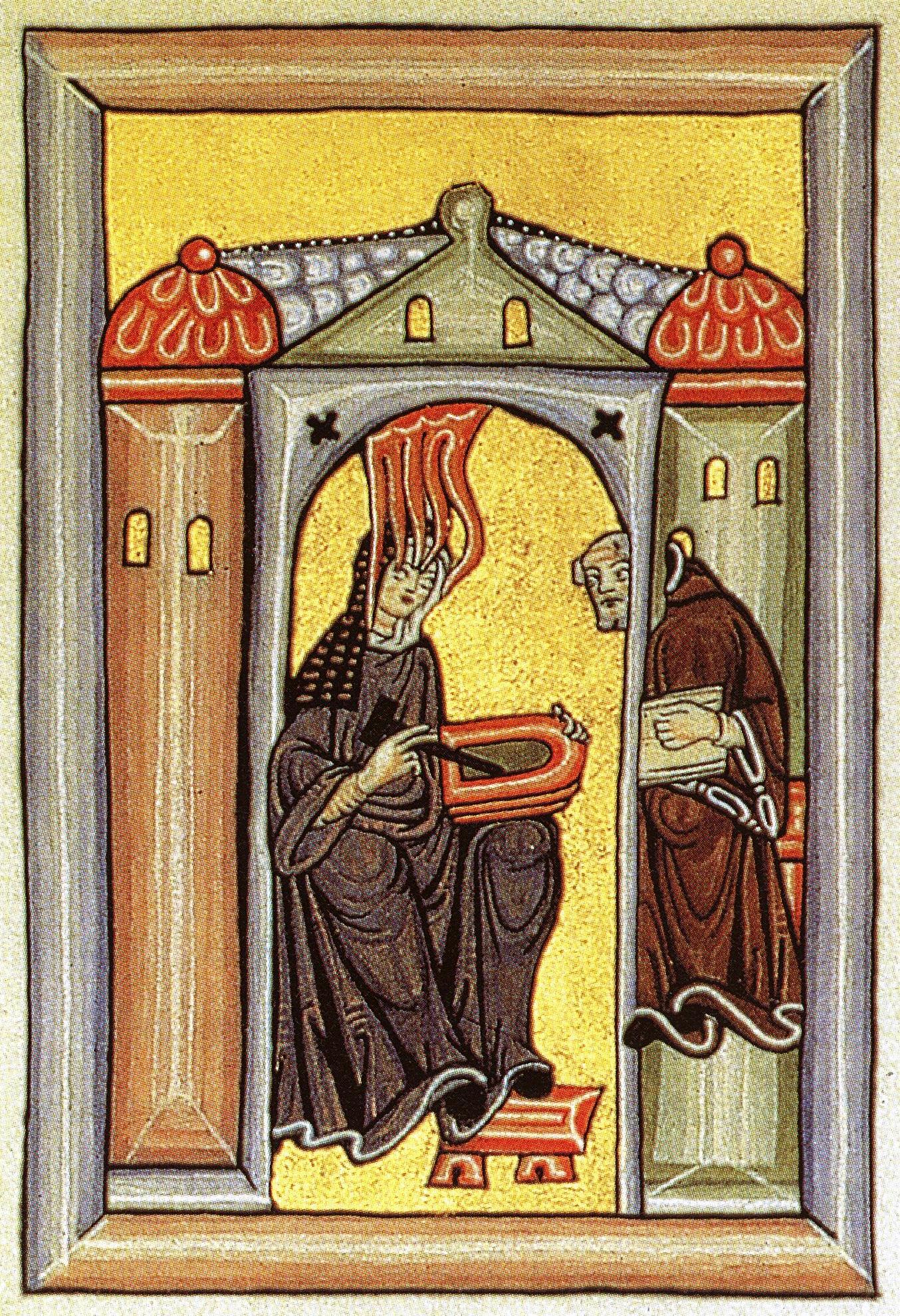
mid-12th century · Hildegard of Bingen · A monastic voice in the Rhineland
Medieval manuscript illumination depicting Hildegard
Illumination from Scivias depicting Hildegard and her scribe · public domain

Music in its historical setting · Medieval · Germany

Hildegard’s music belongs to the 12th-century monastic world, before the English parish milestone of c.1200–1500. She lived in the Rhineland, not England. Her sacred songs offer a continental view of women’s contribution to medieval worship.

In O viridissima virga, follow the unaccompanied melodic line as it rises and unfolds. This is a different sound-world from the interweaving polyphony of the Renaissance.

Listen to an example

O viridissima virga — Hildegard

The Marian Consort

Explore Hildegard of Bingen in the Music Library →

1170 · Becket is killed at Canterbury
Medieval manuscript depiction of knights attacking Thomas Becket.
The killing of Thomas Becket, medieval illumination made after the event, c.1200. British Library, Harley MS 5102, f.32. Public domain via Wikimedia Commons. Image source & larger view.

Henry II helped make his friend and chancellor Thomas Becket Archbishop of Canterbury in 1162. A cooperative archbishop might have been convenient. Instead, king and archbishop came into bitter conflict over the boundaries of royal and ecclesiastical power.

On 29 December 1170, four knights confronted and killed Becket in his cathedral. His tomb became a destination for pilgrims. The episode brings the ambitions of rulers and churchmen into brutally sharp focus.

The famous angry sentence often put into Henry’s mouth should not be treated as a securely recorded quotation. The conflict and the killing are firmer ground than a perfectly polished line of dialogue.

Think about place: a church can hold memories of violence as well as prayer. Canterbury tells Becket’s story.

Listen to an example

Iacet granum — a chant for Thomas Becket

Egeria Voices

This chant commemorates Becket after his death. It connects the story of his killing with the liturgical remembrance that grew around him; it is not music sung during the attack in 1170.

Explore early and medieval sacred music →

Read about this musical connection.

c.1200–1500 · Parishes, monasteries and daily prayer
Medieval manuscript scenes of the Last Supper and the washing of the disciples’ feet.
Last Supper and Washing of the Apostles’ Feet, British manuscript leaf, c.1250–70. A later depiction of Gospel events. Metropolitan Museum of Art, 22.24.3; public domain. Image source & larger view.

For most people, Christian life was encountered in the parish: baptism, marriage, worship, burial and the changing festivals of the year. Monasteries and nunneries maintained another rhythm of prayer, work and learning. Cathedrals, shrines and pilgrimage routes connected local places with a wider western Church in communion with Rome.

Latin worship, plainchant and developing polyphony belonged within that world. It contained devotion and learning, but also inequalities, disputes and calls for reform. Later Catholic and Anglican histories both inherit parts of this medieval landscape.

For choristers: the daily offices help explain why singing psalms became such an enduring practice. From offices to Evensong · Religion in medieval England.

Listen to an example

Viderunt omnes — Pérotin

The Hilliard Ensemble

Pérotin’s Viderunt omnes places elaborate upper voices over a sustained chant. It offers a cathedral-scale example of medieval worship, rather than the everyday music of every parish.

Explore the medieval music guide →

1215 · The Fourth Lateran Council regulates Christian life
Matthew Paris’s manuscript illustration of the Fourth Lateran Council
Matthew Paris, Fourth Lateran Council, Chronica Maiora, c.1250. A later medieval account of the 1215 gathering. Public domain. Image source & larger view.

Pope Innocent III’s council at the Lateran in Rome addressed doctrine, church discipline and the responsibilities of clergy and laity. Its requirements for annual confession and Easter communion helped shape the pattern of western parish religion.

This was also a Church that enforced boundaries harshly. The council’s discriminatory provisions concerning Jews and Muslims belong in the account alongside its pastoral reforms. Medieval religious history contains exclusion as well as devotion, learning and artistic achievement.

Read the council’s canons in translation.

Listen to an example

Viderunt omnes — Pérotin

The Hilliard Ensemble

Polyphony from around the turn of the thirteenth century gives a musical comparison for this period of western church life. It is not presented as music performed at the council or as an illustration of all its decisions.

Explore the medieval music guide →

13th century · Chant and early polyphony

Music in its historical setting · The wider medieval sound-world

Medieval worship included chant sung as a single line and increasingly elaborate music in several parts. One way of hearing early polyphony is to follow a sustained chant foundation while other voices move above it.

This is a musical view of the period, rather than a composition commissioned for the council of 1215. Compare the texture with the later Renaissance examples elsewhere in the timeline.

Listen to an example

Viderunt omnes — Pérotin

The Hilliard Ensemble

Hear the sustained chant beneath the moving upper voices.

Explore the medieval music guide →

Historical reference: Fordham University: medieval music.

1378–1417 · Rival papal claimants divide the western Church
A medieval illustration of Martin V’s coronation at Constance
Martin V at Constance, from the manuscript tradition of Ulrich Richental’s chronicle, 15th century. A later account of the events of 1417. Public domain. Image source & larger view.

From 1378, rival claimants based in Rome and Avignon divided the allegiance of rulers and churches. A later attempt to resolve the conflict produced a third line of claimants rather than immediate unity.

The Council of Constance and the election of Martin V in 1417 brought the main division to an end. This was a crisis within the western Church, distinct from the earlier separation between eastern and western Christianity. It raised lasting questions about the relationship between popes, councils and reform.

UNESCO: Richental’s chronicle of the Council of Constance.

Listen to an example

Nuper rosarum flores — Dufay

Huelgas Ensemble

Dufay’s Nuper rosarum flores was written in 1436, after the main Western Schism ended in 1417. It offers a later comparison: sacred ceremony and musical patronage continued beyond the crisis.

Explore Guillaume Dufay in the Music Library →

late 14th–early 15th century · Sacred music amid division

Music in its historical setting · Institutions, patrons and prayer

Rival claims to church authority did not stop communities from worshipping. Cathedrals, religious houses and courts continued to sustain musicians and liturgical practice within a divided western Church.

The institutional setting matters when reading a composer’s biography. Service to a chapel or patron does not by itself tell us every detail of a musician’s convictions.

Listen to an example

Nuper rosarum flores — Dufay

Huelgas Ensemble

A comparison from 1436, after the Western Schism ended: music for the consecration of Florence Cathedral, rather than a work composed for the Schism.

Explore the medieval musical setting →

Historical reference: Richental’s chronicle and the Council of Constance.

1436 · Guillaume Dufay · Music for Florence Cathedral
Guillaume Dufay at left, pictured with Gilles Binchois in a historical manuscript
Dufay (left) with Gilles Binchois · historical manuscript depiction · public domain. Image source.

Music in its historical setting · Early Renaissance · Italy

Dufay’s Nuper rosarum flores was written for the consecration of Florence Cathedral in 1436. Its ceremonial polyphony belongs within the later medieval and early Renaissance Church, well before England’s break with Rome.

Listen for long musical patterns beneath the more active voices. Dufay’s work connects the architecture of a great church with the ordered sound of a ceremonial motet.

Listen to an example

Nuper rosarum flores — Dufay

Huelgas Ensemble

Explore Guillaume Dufay in the Music Library →

Historical reference: Florence Cathedral: consecration.

1453 · Constantinople falls to the Ottomans
Byzantine mosaic in Hagia Sophia, depicting Mary and Christ between emperors
Southwestern entrance mosaic, Hagia Sophia, depicting Mary and Christ with Justinian and Constantine. An illustration of Byzantine Christian art, not a depiction of the conquest of 1453. Photo: Myrabella, CC0; artwork public domain. Image source & larger view.

The Ottoman conquest of Constantinople ended the Byzantine Empire. Hagia Sophia, long the great cathedral of the imperial capital, became a mosque. For eastern Christians, the loss of the city transformed the political setting of religious life.

It did not end Orthodox Christianity or its worship. Communities, monasteries and traditions continued under changed conditions and across a much wider geographical world. This milestone helps keep the western Catholic and Anglican story in view as part of a larger Christian history.

The Metropolitan Museum: Hagia Sophia.

Listen to an example

Cherubic Hymn in Mode 1

Cappella Romana · Icons of Sound

The Byzantine chant tradition continued beyond the fall of the imperial capital. This modern performance recalls the medieval inheritance, without claiming to reproduce music heard during the conquest.

Explore Orthodox chant resources →

1453 onwards · Byzantine chant continues

Music in its historical setting · An eastern Christian inheritance

The fall of Constantinople did not bring its musical inheritance to an end. Orthodox singers continued to transmit and develop traditions of chant in the centuries that followed.

This repertory has its own notation, modes and performance practices. It offers a valuable comparison with western plainchant and with the Anglican choral sound familiar to many readers.

Listen to an example

Cherubic Hymn in Mode 1

Cappella Romana · Icons of Sound

A modern performance of medieval Byzantine chant with a simulation of Hagia Sophia’s acoustics; not a recording or reconstruction of its sixth-century dedication.

Explore Orthodox chant resources →

Historical reference: The Archdiocesan School of Byzantine Music: a historical survey.

c.1500 · Josquin des Prez · Sacred words pass from voice to voice
Later woodcut traditionally identified as Josquin des Prez
Later woodcut traditionally identified as Josquin · public domain

Music in its historical setting · Renaissance · Continental Europe

Around 1500, Josquin’s career linked churches and courts in France and Italy. His Masses and motets belong to the Renaissance Catholic world before the English Reformation.

In Ave Maria … virgo serena, listen for one voice taking up another’s musical idea, then for the points where the separate lines come together. The date here locates his musical world; it is not a precise composition date for the motet.

Listen to an example

Ave Maria … virgo serena — Josquin

VOCES8

Explore Josquin des Prez in the Music Library →

1517 · Luther challenges the sale of indulgences
Lucas Cranach’s portrait of Martin Luther
Lucas Cranach the Elder, Martin Luther, 1529. Painted after the controversy of 1517. Public domain. Image source & larger view.

Martin Luther’s Ninety-Five Theses challenged the teaching and practice surrounding indulgences. The controversy of 1517 developed into wider arguments over authority, salvation and the interpretation of Scripture.

Printing helped the disputes travel. The resulting Lutheran Reformation followed a different course from Henry VIII’s later break with Rome: the changes were connected across Europe, but were not a single national story. Vernacular preaching and congregational song became important features of Lutheran worship.

The Evangelical Church in Germany: the Ninety-Five Theses.

Listen to an example

Ein feste Burg ist unser Gott, BWV 80 — Bach

Netherlands Bach Society · Shunske Sato

Bach’s later cantata develops Luther’s hymn Ein feste Burg. It lets readers hear a musical inheritance of the Reformation; neither the cantata nor the hymn belongs to the original 1517 theses.

Explore the later inheritance in Bach →

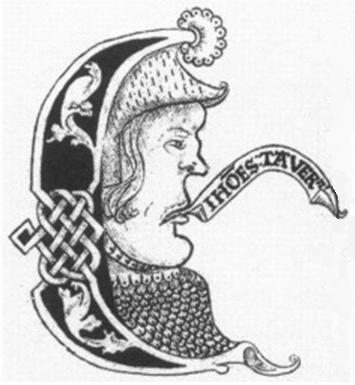
1520s–1530s · John Taverner · The early Tudor choral inheritance
Possible historical likeness of John Taverner
Possible likeness in the Forrest-Heyther partbooks · public domain

Music in its historical setting · Early Tudor · England

Taverner directed the choir at Cardinal College, Oxford. His music opens a window onto the Latin choral tradition inherited by the English Reformation: richly developed polyphony within a college and church setting.

Explore Dum transisset Sabbatum and follow a single part through the texture. This point belongs to early Tudor England, before and around the first institutional changes of the 1530s.

Listen to an example

Dum transisset Sabbatum — Taverner

Trinity College Choir, Cambridge

Explore John Taverner in the Music Library →

1524 · The Lutheran hymnbook

Music in its historical setting · Faith in the congregation’s voice

The first Lutheran hymnbook, the Achtliederbuch, appeared in 1524. Singing in the vernacular gave communities a way to learn and express the teachings of the Reformation together.

The chorale became an enduring part of Lutheran musical life. Bach’s much later work in Leipzig is one continuation of that tradition; his own dated portrait appears further down this timeline.

Listen to an example

Ein feste Burg ist unser Gott, BWV 80 — Bach

Netherlands Bach Society · Shunske Sato

Bach’s later cantata develops Luther’s hymn; this is not music composed in 1524.

Explore the later inheritance in Bach →

Historical reference: The Lutheran World Federation: five centuries of hymnbooks.

1534 · Henry VIII breaks with papal authority
Hans Holbein the Younger’s portrait of Henry VIII, wearing a richly decorated cap and coat.
Henry VIII, Hans Holbein the Younger, c.1537. Museo Nacional Thyssen-Bornemisza, Madrid. Public-domain reproduction via Wikimedia Commons. Image source & larger view.

Parliament’s Act of Supremacy declared Henry VIII supreme head on earth of the Church of England. This severed its institutional allegiance to the Pope. Royal marriage, political authority and religious argument were intertwined.

The break did not instantly produce the later Anglican pattern of worship or make Henry a straightforward Protestant. Further changes under Edward VI, Mary I and Elizabeth I would lead in sharply different directions. Some people who resisted royal supremacy were executed; conscience could carry a terrible cost.

Read Parliament’s account of the Act.

Listen to an example

Dum transisset Sabbatum — Taverner

Trinity College Choir, Cambridge

Taverner’s Latin sacred polyphony opens a window on the English musical world across the break with Rome. Listen to the inherited texture; the work is not a setting of, or commission for, the Act of Supremacy.

Explore John Taverner in the Music Library →

1536–1540 · The monasteries are dissolved
William Richardson’s nineteenth-century watercolour view of the ruins of Whitby Abbey.
Whitby Abbey, 19th-century watercolour by William Richardson. The later medieval ruins are not the buildings where the synod met in 664. Public domain via Wikimedia Commons. Image source & larger view.

Henry VIII’s government closed England’s monasteries and nunneries and took their property. Their communities were dispersed, and many buildings were dismantled or adapted. Some churches survived in new roles.

This was a profound rupture in the places that had sustained daily sung offices. Ruined abbeys can look timeless, but their silence has a political and religious history. Not every ruined wall dates from the moment of closure.

Follow the fate of St Augustine’s Abbey.

Listen to an example

Dum transisset Sabbatum — Taverner

Trinity College Choir, Cambridge

The Latin responsory preserves a sound-world associated with pre-Reformation worship. It gives a musical perspective on an inheritance disrupted by religious change, rather than a soundtrack to the dissolution itself.

Explore John Taverner in the Music Library →

1540s–1580s · Thomas Tallis · A composer across four changing reigns
Historical portrait of Thomas Tallis
Later engraving of Thomas Tallis · public domain

Music in its historical setting · Tudor Reformation · England

Tallis served under Henry VIII, Edward VI, Mary I and Elizabeth I. His long career crosses the major reversals shown in the surrounding milestones, rather than belonging to only one settlement.

If ye love me gives a concise example of his English sacred writing. Compare its clear handling of words with his Latin music. This date range describes his mature career, not the date of every work.

Listen to an example

If ye love me — Tallis

King’s College Choir, Cambridge

Explore Thomas Tallis in the Music Library →

1545–1563 · The Council of Trent defines a Catholic response
Historical painting of bishops assembled at the Council of Trent
Council of Trent, unknown artist, c.1600, Museo Diocesano Tridentino. A later representation of the council. Public domain. Image source & larger view.

Meeting in several periods between 1545 and 1563, the Council of Trent affirmed Catholic teaching and addressed the reform of clergy, worship and church life. Its decisions became central to the Catholic response to the Protestant Reformations.

Music formed one part of that discussion. The council’s decree on the celebration of Mass excluded music associated with impure or worldly elements. It did not issue a simple universal ban on polyphony. The familiar story of Palestrina single-handedly saving church music compresses a complicated history into a legend.

Read the council’s 1562 decree on Mass.

Listen to an example

Credo — Palestrina

The Tallis Scholars

Palestrina’s Credo offers an example of Catholic polyphony continuing in the later sixteenth century. It is not evidence for the familiar story that one Mass “saved” polyphony at Trent.

Explore Palestrina’s sacred music →

1545–1563 · Music and Catholic reform

Music in its historical setting · Polyphony remains in worship

Trent’s decisions on music must be read within a larger concern for reverence and the liturgy. Its 1562 decree rejected impure or worldly elements in church music; it did not abolish music in several parts.

Palestrina and Victoria show the continuing vitality of Catholic polyphony in the later sixteenth century. Their composer profiles offer musical comparisons with the English Reformation story.

Listen to an example

Credo — Palestrina

The Tallis Scholars

A later-sixteenth-century example of Catholic polyphony, rather than music performed at the Council itself.

Explore Palestrina’s sacred music →

Historical reference: Trent: decree on the celebration of Mass.

1549 · An English prayer book
Decorated black-letter title page of the 1549 Book of Common Prayer.
Title page of the Book of Common Prayer, 1549. British Library reproduction via Wikimedia Commons; public domain. Image source & larger view.

The English Reformation was not one tidy event. Royal policy, religious conviction and rival claims to authority changed lives, institutions and the words people heard in church. Thomas Cranmer’s 1549 Book of Common Prayer made a single English service book central to the new order.

Revisions followed. What looked permanent could be overturned under another monarch; convictions could become dangerous. The story contains courage, ambition and persecution on different sides, not a convenient division into flawless heroes and obvious villains.

In the stalls: the pairing of Magnificat and Nunc dimittis links today’s Evensong to this history. Open the old title page and then look at a modern service sheet: continuity and change sit together. See the 1549 Prayer Book · Follow its revisions.

Listen to an example

Communion setting — Merbecke

St John’s Church, Detroit

Merbecke published his setting of the 1549 Prayer Book in 1550. This modern service performance uses the version printed in the 1940 Episcopal Hymnal, showing the later life of those melodies.

Explore Merbecke’s notated service →

1550 · Merbecke sets the English service

Music in its historical setting · The Book of Common Prayer Noted

John Merbecke’s Book of Common Prayer Noted appeared in 1550. It adapted chant to the English words of the 1549 Prayer Book, giving the new liturgy a musical form.

The second Prayer Book of 1552 soon changed the textual setting again. Merbecke’s later reception is another part of the story: familiar modern versions are not always identical to the original printing.

Listen to an example

Communion setting — Merbecke

St John’s Church, Detroit

A modern service performance in the version printed in the 1940 Episcopal Hymnal; the melodies derive from Merbecke’s setting published in 1550.

Explore Merbecke’s notated service →

Historical reference: The 1550 service and its music.

1552 · A second Prayer Book changes the Communion service
Gerlach Flicke’s portrait of Archbishop Thomas Cranmer
Gerlach Flicke, Thomas Cranmer, 16th century, National Portrait Gallery, London. Public domain. Image source & larger view.

The second Prayer Book of Edward VI appeared in 1552. It revised the Communion service and other parts of worship, showing how quickly the English Reformation continued to move after the first English book of 1549.

The new settlement was short-lived: Mary I’s accession in 1553 brought another reversal. Later Prayer Books would return to and adapt parts of this inheritance. For singers, a change in authorised wording could alter both the texts to be set and the place of music within a service.

Explore the 1552 Prayer Book text.

Listen to an example

Communion setting — Merbecke

St John’s Church, Detroit

Compare Merbecke’s music for the 1549 book, published in 1550, with the account of the 1552 revision. The recording uses a later adaptation; it is not a new setting written for the second Prayer Book.

Explore the shape of the sung Eucharist →

1552 · When the words change

Music in its historical setting · Liturgy and musical setting

A revised service book changes more than the page held by the minister. It can alter a choir’s texts, the congregation’s responses and the points at which music is needed.

The Prayer Book revisions invite a practical comparison: put two versions of a service side by side and notice what is moved, shortened or reworded. A later musical setting may reflect a different text from the one first published in 1549.

Listen to an example

Communion setting — Merbecke

St John’s Church, Detroit

For comparison: a modern version of Merbecke’s music for the 1549 Prayer Book, published in 1550, not a new setting written for the 1552 revision.

Explore the shape of the sung Eucharist →

Historical reference: The second Prayer Book of Edward VI.

1553–1558 · Mary I restores communion with Rome
Mary I seated in Antonis Mor’s portrait, holding a red rose.
Mary I, Antonis Mor, 1554. Museo del Prado, Madrid. Public-domain reproduction via Wikimedia Commons. Image source & larger view.

Under Mary I, England returned to communion with Rome and Catholic worship was restored. The reversal followed the Protestant reforms of Edward VI. Her reign also brought the persecution and burning of Protestants, including Archbishop Thomas Cranmer.

A change of monarch could transform public worship and put deeply held convictions at risk. Mary’s death in 1558 brought another change of direction.

Parliament’s overview of the Reformation.

Listen to an example

Loquebantur variis linguis — Tallis

Taverner Consort & Choir

Tallis’s Latin Pentecost responsory offers a comparison with the Catholic sacred repertory of Tudor England. It is not presented as a documented performance at Mary’s court or as a work securely dated to her reign.

Explore Thomas Tallis in the Music Library →

1559 · Elizabeth’s religious settlement
The Darnley portrait of Elizabeth I, in an elaborate dress and jewellery.
Elizabeth I, the Darnley portrait, c.1575, unknown artist. National Portrait Gallery, London. Public-domain reproduction via Wikimedia Commons. Image source & larger view.

Elizabeth I’s settlement re-established royal supremacy, with the monarch styled Supreme Governor, and required a revised Book of Common Prayer. It helped shape the continuing Church of England.

It did not bring agreement or full religious freedom. Roman Catholics who refused the established worship faced penalties, while Protestants also disputed the settlement’s limits. Catholics continued to practise their faith, sometimes through discreet household worship and visiting priests.

Listen next: Byrd’s career makes these tensions audible. Explore Byrd · The settlement in context.

Listen to an example

If ye love me — Tallis

King’s College Choir, Cambridge

Tallis’s English anthem illustrates a strand of the musical inheritance heard in the reformed Church. The work is not dated here to 1559 or treated as a commission for Elizabeth’s settlement.

Explore Thomas Tallis in the Music Library →

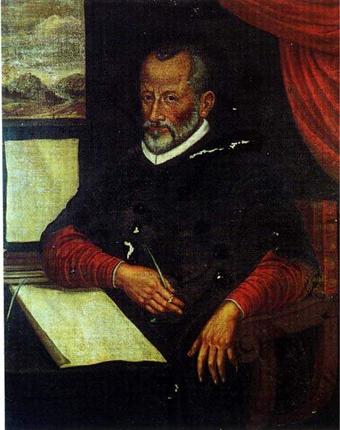
1560s–1590s · Giovanni Pierluigi da Palestrina · Catholic polyphony in Renaissance Rome
Portrait traditionally identified as Giovanni Pierluigi da Palestrina
Portrait, c. 1590 · public domain

Music in its historical setting · Renaissance · Rome

Palestrina worked in the musical institutions of Rome, including churches associated with the papacy. His sacred polyphony belongs to the later 16th-century Catholic Church. It should not be placed in Mary I’s English court or treated as an Anglican development.

The Missa Brevis in the library offers a route into his Mass writing. Listen to the balance between a flowing individual line and the clarity of the whole texture.

Listen to an example

Missa Brevis — selected movements

Recording from the Music Library

Explore Giovanni Pierluigi da Palestrina in the Music Library →

1563–1571 · The Thirty-Nine Articles give the settlement a doctrinal voice
Sixteenth-century portrait of Archbishop Matthew Parker
Matthew Parker, unknown artist, 16th century. Archbishop of Canterbury during the framing of the Elizabethan Articles. Public domain. Image source & larger view.

The Articles associated with the Elizabethan settlement took shape in 1563 and reached their final form in 1571. They addressed contested questions about Scripture, the Church, the sacraments and religious authority.

They are a doctrinal text rather than a musical rulebook. Yet Article XXIV’s insistence that public prayer be understood by the people has an obvious bearing on the language heard in worship. Anglican history includes argument over interpretation as well as agreement on a shared text.

Read the Articles of Religion.

Listen to an example

If ye love me — Tallis

King’s College Choir, Cambridge

Listen to the clear English text in Tallis’s anthem alongside Article XXIV’s concern with a language understood by the people. This is a musical comparison, not a setting of the Articles.

Explore language and music in Evensong →

1563–1571 · Words the people can understand

Music in its historical setting · Language, worship and Article XXIV

Article XXIV addresses public prayer and the sacraments in a language understood by the people. It places language within the religious arguments of the Elizabethan settlement.

For singers, clarity also involves delivery: the words on the page must become intelligible speech within music. The article is not an instruction to abandon artistic complexity, nor a description of every later Anglican musical practice.

Listen to an example

If ye love me — Tallis

King’s College Choir, Cambridge

An English-text anthem illustrating the emphasis on intelligible words.

Explore language and music in Evensong →

Historical reference: Article XXIV in the Articles of Religion.

1570s–1610s · Tomás Luis de Victoria · A sacred voice between Rome and Spain
Historical portrait of Tomás Luis de Victoria
Historical portrait of Victoria, artist unknown · public domain

Music in its historical setting · Renaissance · Rome & Spain

Victoria’s career connected Rome with Spain, and later a royal convent in Madrid. His sacred music belongs to the late Renaissance, alongside the mature careers of Palestrina and Byrd, but within different institutions.

Begin with O magnum mysterium, then explore the Mass settings on his profile. Listen to the expressive weight of an entry, a pause or a shared cadence.

Listen to an example

O magnum mysterium — Victoria

The Sixteen

Explore Tomás Luis de Victoria in the Music Library →

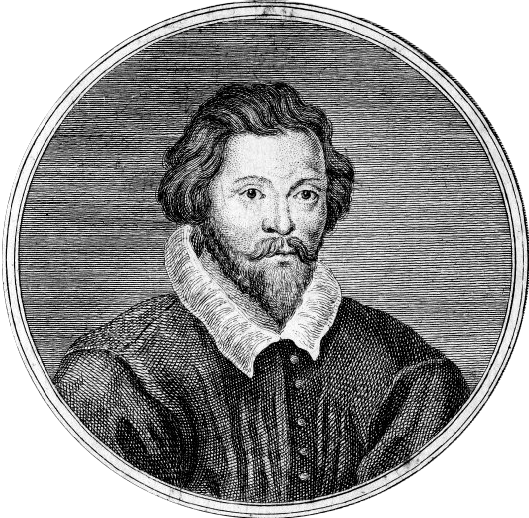
1572 · Byrd joins the Chapel Royal
Later engraved portrait of the composer William Byrd.
William Byrd, 18th-century engraved portrait: a posthumous likeness, not a contemporary portrait. Public domain; digital reproduction by Rettinghaus via Wikimedia Commons. Image source & larger view.

William Byrd served Elizabeth I in the Chapel Royal, which he joined in 1572. He also remained a committed Catholic and wrote music for Catholic worship. His career resists a simple label: he belonged to the royal musical establishment while serving a religious community under pressure.

That tension gives the music a human setting. An English anthem and a Latin Mass are not just contrasting exercises in composition; they emerge from a world in which worship, loyalty and conscience could pull in different directions.

Listen next: explore Byrd’s profile and compare how words travel between his voice parts. Byrd in the Music Library · Byrd and Elizabeth’s Chapel Royal · Byrd’s Catholic musical world.

Listen to an example

Mass for four voices: Kyrie — Byrd

The Tallis Scholars

Byrd’s Mass for four voices belongs to the 1590s, later than his appointment to the Chapel Royal in 1572. It opens the Catholic side of a career that also served the royal establishment.

Explore William Byrd in the Music Library →

1590s · William Byrd · Latin Masses amid English religious division
Engraved portrait of William Byrd
Later engraving by Gerard Vandergucht after Nicola Francesco Haym · public domain

Music in its historical setting · Elizabethan · England

Byrd’s Latin Mass settings belong to the 1590s, two decades after he joined the Chapel Royal in 1572. These are distinct points in his career: royal employment and Catholic musical devotion overlapped.

His profile brings together Latin works such as Ave verum corpus and Haec dies with the wider story of his English church music. Consider how intended worship and the pressure on Catholic communities give the music a historical setting.

Listen to an example

Mass for four voices: Kyrie — Byrd

The Tallis Scholars

Explore William Byrd in the Music Library →

1605 · The Gunpowder Plot deepens anti-Catholic suspicion
Engraved portraits of the Gunpowder Plot conspirators
The Gunpowder Plot conspirators, engraving by Crispijn van de Passe the Elder, 1605. Public domain. Image source & larger view.

The discovery of the Gunpowder Plot on 5 November 1605 prevented an attempt to kill James I and destroy Parliament. Its Catholic conspirators acted within a wider setting of religious exclusion and frustrated hopes for relief.

Their actions intensified suspicion of Catholics generally. Annual thanksgiving services and sermons helped shape Protestant memory of the event. The history must distinguish the conspirators from the many Catholics who neither joined nor supported their plans.

UK Parliament: the plot’s aftermath.

Listen to an example

Ave verum corpus — Byrd

Somerville College Choir, Oxford

Ave verum corpus comes from Byrd’s first Gradualia collection, published in 1605. It offers a Catholic devotional perspective from the same year, without implying any connection with the conspirators or their plot.

Explore William Byrd in the Music Library →

1605 · William Byrd · Gradualia and Catholic worship
Engraved portrait of William Byrd
Later engraving by Gerard Vandergucht after Nicola Francesco Haym · public domain

Gradualia and Catholic worship

The first collection of Byrd’s Gradualia appeared in 1605, providing Latin music for the Catholic liturgical year. A second collection followed in 1607.

The shared date with the Gunpowder Plot does not make the music a response to it. The historical connection is the precarious setting of Catholic worship in early Stuart England. Byrd’s profile offers related motets and the wider story of his musical life.

Listen to an example

Ave verum corpus — Byrd

Somerville College Choir, Oxford

From the first book of Gradualia (1605).

Explore William Byrd in the Music Library →

Historical reference: The Diocese of Westminster: Byrd’s Gradualia.

1611 · The King James Bible is published
Decorated title page of the King James Bible of 1611
Title page of the King James Bible, 1611, engraved by Cornelis Boel. Public domain. Image source & larger view.

The Bible published in 1611 followed the translation project initiated under James I. It drew on earlier English translations as well as the original languages, and its phrasing became deeply influential in English-speaking religious and literary life.

For a chorister, translation has an audible consequence: familiar biblical words pass into anthems, readings and memory. Distinguish this Bible from the Prayer Book Psalter, whose traditional English wording follows the earlier Coverdale tradition. An anthem’s text needs checking against its own source.

Cambridge University Press: the first edition.

Listen to an example

This is the record of John — Gibbons

King’s College Choir, Cambridge · David Willcocks

Gibbons’s anthem offers an encounter with the English biblical language of his period. Its words draw on John 1; it should not be taken as evidence that the work was composed for the new translation or uses the 1611 text verbatim.

Explore Orlando Gibbons in the Music Library →

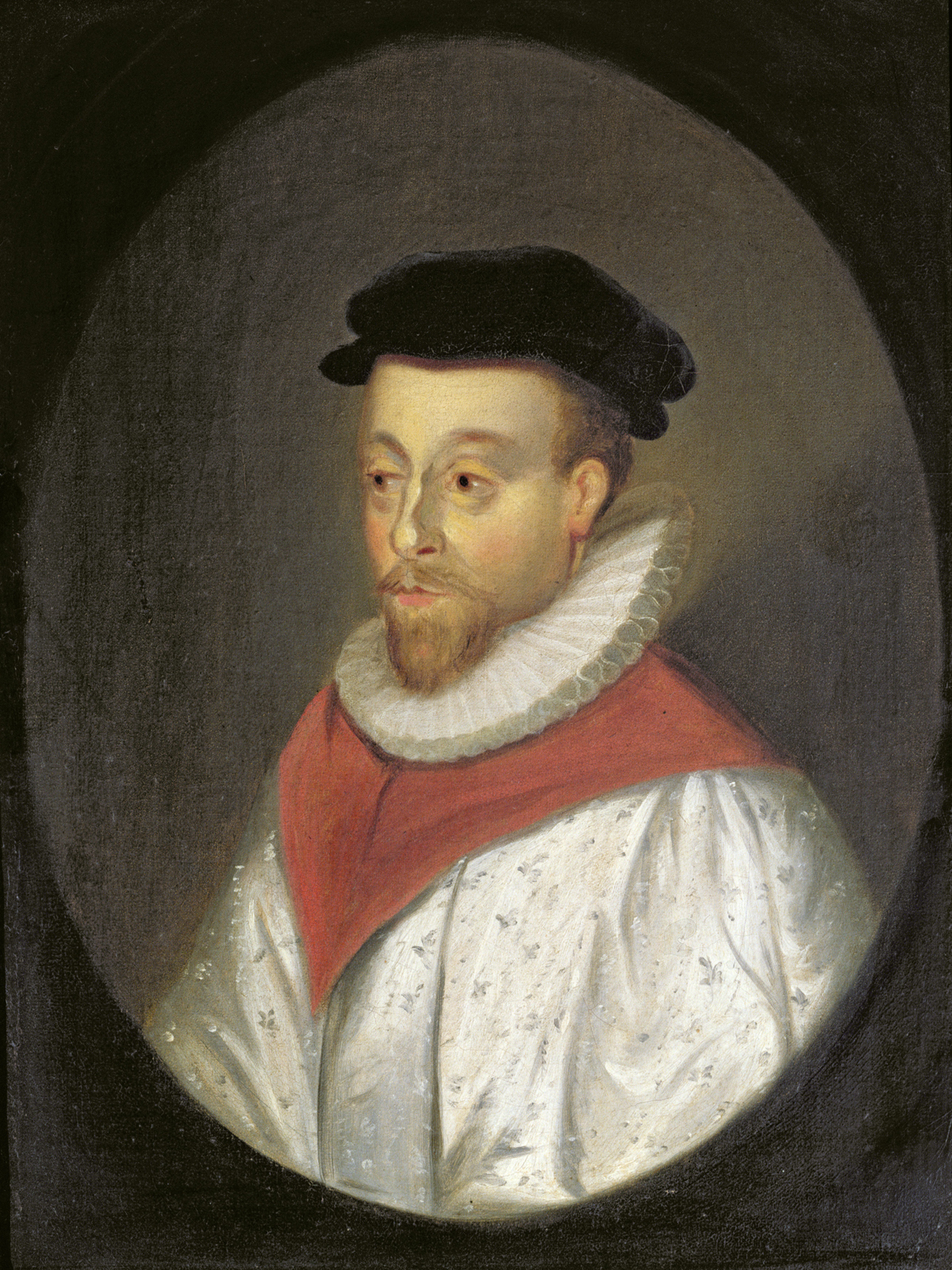
early 17th century · Orlando Gibbons · The English anthem after Elizabeth
Historical portrait of Orlando Gibbons
Seventeenth-century portrait, artist unknown · public domain

Music in its historical setting · Jacobean · England

Gibbons belongs to the generation after the first Elizabethan settlement. His work at the Chapel Royal and Westminster Abbey places him in the early 17th-century Anglican tradition, not at the introduction of the 1549 Prayer Book.

In This is the record of John, solo voice and choir shape the text together. Compare this verse-anthem form with the more continuously shared vocal texture of earlier motets.

Listen to an example

This is the record of John — Gibbons

King’s College Choir, Cambridge · David Willcocks

Explore Orlando Gibbons in the Music Library →

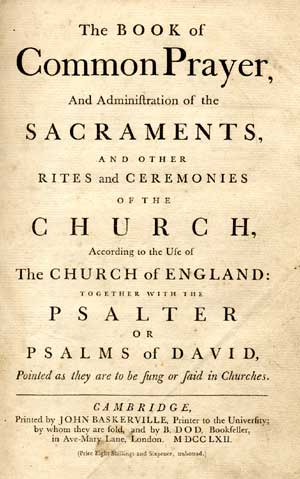
1640s–1662 · A prayer book returns after civil war
The title page of John Baskerville’s 1762 printing of the 1662 Book of Common Prayer.
Title page of the 1662 Book of Common Prayer in John Baskerville’s printing of 1762—not a photograph of a 1662 printing. Public domain via Wikimedia Commons. Image source & larger view.

The civil wars and Commonwealth disrupted the Church of England’s episcopal organisation and public Prayer Book worship. The restoration of the monarchy in 1660 reversed that direction. The revised Prayer Book of 1662 became an enduring reference point for Anglican worship.

The settlement was not painless: clergy unable to accept its requirements lost their posts. Catholic restrictions also continued. The story of a treasured liturgy therefore sits alongside the history of people excluded from the established Church.

In the stalls: traditional Evensong still follows this Prayer Book inheritance. Follow Evensong · The Church of England’s historical overview.

Listen to an example

Fifth Service: He hath put down — Tomkins

Magnificat excerpt · recording from the Music Library

Tomkins’s Fifth Service supplies a musical connection to the canticles and to the tradition that survived the upheavals. The excerpt is not a setting commissioned for the 1662 revision.

Explore Thomas Tomkins in the Music Library →

1640s–1656 · Thomas Tomkins · A cathedral tradition through civil war
TT
No authenticated portrait of Thomas Tomkins is known.

Music in its historical setting · Civil wars · England

Tomkins’s long career at Worcester connected late Tudor and early Stuart church music with the disruption of the civil wars. The later part of his life belongs on the approach to the 1662 settlement, rather than after it: he died in 1656.

His service music, responses and anthems preserve part of the choral inheritance affected by those changes. The date range marks his final historical setting, not the composition dates of all his works.

Listen to an example

Fifth Service: He hath put down — Tomkins

Magnificat excerpt · recording from the Music Library

Explore Thomas Tomkins in the Music Library →

1679 · Henry Purcell · Purcell becomes organist of Westminster Abbey
Historical portrait of Henry Purcell
John Closterman · public domain

Music in its historical setting · Restoration · England

Purcell became organist of Westminster Abbey in 1679, after the return of the monarchy and the 1662 Prayer Book settlement. He belongs to Restoration musical life, not the pre-war generation of Tomkins.

Explore Hear my prayer, O Lord. Its accumulating vocal entries make a short biblical plea intensely expressive. The date above marks his Abbey appointment.

Listen to an example

Hear my prayer, O Lord — Purcell

VOCES8

Explore Henry Purcell in the Music Library →

Historical reference: Westminster Abbey: Purcell.

1689 · The Toleration Act permits some dissenting worship
Engraved portraits of William III and Mary II
William III and Mary II, engraving by R. White, between 1689 and 1703. A portrait of the joint monarchs, not the passing of the Act. Public domain. Image source & larger view.

After the revolution of 1688–1689, Parliament allowed qualifying Protestant dissenters to worship in licensed meeting houses. The established Church of England continued, but religious life could no longer be described only through its parish churches.

This was limited toleration, not equal religious citizenship. Catholics and others remained outside its protection, and civil restrictions persisted. The development of dissenting congregations also created settings in which psalm singing and, increasingly, hymns could develop their own identities.

UK Parliament: Catholics and nonconformists.

Listen to an example

When I survey the wondrous cross

King’s College Choir, Cambridge · Stephen Cleobury

Watts’s hymn text appeared in 1707, after the Toleration Act. This later tune and arrangement illustrate the growing hymn tradition associated with dissenting worship, not a performance from 1689.

Explore a later collection of Watts’s psalms and hymns →

1707 · Hymns beyond the parish church

Music in its historical setting · Isaac Watts and dissenting worship

Isaac Watts’s Hymns and Spiritual Songs appeared in 1707. His writing belongs to the growing culture of English dissenting worship, alongside the continuing use of metrical psalms.

A hymn text and a tune have separate histories: the melody a congregation sings today may have been paired with the words much later. Notice both credits when looking at a hymnbook.

Listen to an example

When I survey the wondrous cross

King’s College Choir, Cambridge · Stephen Cleobury

Watts’s text in a later musical setting and arrangement; the recording does not recreate a 1707 performance.

Explore a later collection of Watts’s psalms and hymns →

Historical reference: Hymn Studies: Watts’s publications.

1723 · Johann Sebastian Bach · Bach becomes Thomaskantor in Leipzig
Historical portrait of Johann Sebastian Bach
Elias Gottlob Haussmann, 1748 · public domain

Bach becomes Thomaskantor in Leipzig

Bach became Thomaskantor in Leipzig in 1723, taking responsibility for music in the city’s principal churches. His cantatas and Passions bring biblical narrative, poetry and chorales into a richly organised musical life.

This is the German Lutheran story, rather than a consequence of England’s Toleration Act. Compare the choral handling of words in the St John Passion with the more familiar Anglican anthem tradition.

Listen to an example

St John Passion: opening chorus — Bach

King’s College Choir, Cambridge · Stephen Cleobury

Explore Johann Sebastian Bach in the Music Library →

Historical reference: Bach-Archiv Leipzig: Bach’s arrival in 1723.

1739 · Methodist preaching moves beyond the church walls
George Romney’s portrait of John Wesley
George Romney, John Wesley, 18th century; National Portrait Gallery, London. A later portrait of the Methodist preacher. Public domain. Image source & larger view.

In 1739 John Wesley began open-air preaching in the Bristol area after George Whitefield’s invitation. Methodist societies developed patterns of fellowship and discipline. John and Charles Wesley were Anglican clergy; Methodism’s emergence as a separate church was a longer process.

Singing helped people learn, remember and express belief. Charles Wesley’s hymns became a major part of that inheritance. He is not Samuel Sebastian Wesley, the nineteenth-century cathedral composer: the later musician was Charles’s grandson.

Methodist Heritage: the movement’s history.

Listen to an example

Love divine, all loves excelling

King’s College Choir, Cambridge · Stephen Cleobury

Charles Wesley’s words show how hymn singing could carry theology beyond a sermon. The musical setting heard here is later; this does not recreate an open-air gathering in 1739.

Explore Methodism’s singing tradition →

1730s–1740s onwards · Charles Wesley’s hymns

Music in its historical setting · Theology learnt through singing

Charles Wesley’s hymns give the Methodist movement a particularly rich vocabulary of faith, assurance and praise. Singing served fellowship and teaching as well as private devotion.

Charles was a hymn writer and Anglican clergyman. His grandson Samuel Sebastian Wesley belongs to the later cathedral tradition: the family connection is real, but their dates and musical settings are different.

Listen to an example

Love divine, all loves excelling

King’s College Choir, Cambridge · Stephen Cleobury

Charles Wesley’s hymn in a later setting associated with Stainer; an example of the continuing hymn tradition.

Explore Methodism’s singing tradition →

Historical reference: The Methodist Church: Charles Wesley and hymnody.

1742 · George Frideric Handel · Messiah is first performed in Dublin
Historical portrait of George Frideric Handel
Attributed to Balthasar Denner · public domain

Music in its historical setting · Georgian · Ireland & Britain

Messiah received its first performance in Dublin in 1742. Handel’s English oratorio extends the sacred story into the public concert world of the 18th century.

It is not a setting of the Book of Common Prayer or a product of the 1662 settlement. On his profile, follow the biblical words through the choruses and hear how their character changes from movement to movement.

Listen to an example

Messiah: Hallelujah — Handel

King’s College Choir, Cambridge

Explore George Frideric Handel in the Music Library →

Historical reference: Trinity College Dublin: music in 18th-century Dublin.

1791 · Catholic relief widens freedom of worship
Thomas Gainsborough’s portrait of William Pitt the Younger
William Pitt the Younger, Thomas Gainsborough, 1784. Pitt was prime minister when the 1791 Act was passed. Public domain. Image source & larger view.

The Catholic Relief Act of 1791 granted important relief from penal restrictions to Catholics who took the required oath. Freedom of worship was a central change, allowing Catholic religious life a more secure public footing.

This was a stage in a longer process, not the arrival of equal rights in every sphere. The parliamentary settlement of 1829 and the restoration of diocesan structures in 1850 were separate later developments. Keeping these dates apart helps explain how legal and institutional change unfolded.

UK Parliament: the Catholic Relief Act of 1791.

Listen to an example

Mass for four voices: Kyrie — Byrd

The Tallis Scholars

An earlier Catholic musical inheritance: Byrd’s Mass was published in the 1590s, long before the 1791 relief legislation. Listening back gives a comparison with the devotional tradition that survived periods of restriction.

Explore William Byrd in the Music Library →

1798 · Joseph Haydn · The Creation brings the biblical story to the concert hall
Historical portrait of Joseph Haydn
Thomas Hardy · public domain

The Creation brings the biblical story to the concert hall

Haydn’s The Creation received its first performances in Vienna in 1798. Its choruses turn the biblical creation story into vivid musical scenes, including the emergence of light and the praise of the heavens.

This is a wider European musical reference from the period, not a work commissioned for England’s Catholic Relief Act. His profile leads to The heavens are telling and a contrasting sacred concert tradition.

Listen to an example

The Creation: The heavens are telling — Haydn

King’s College Choir, Cambridge · David Willcocks

Explore Joseph Haydn in the Music Library →

Historical reference: Haydn2032: Haydn’s life and The Creation.

1829 · Catholic emancipation
An 1847 portrait print of Daniel O’Connell.
Daniel O’Connell, Alfred M. Hoffy, 1847. Library of Congress. Public-domain reproduction via Wikimedia Commons. Image source & larger view.

The Roman Catholic Relief Act allowed Catholics to sit in Parliament and hold most public offices. Daniel O’Connell and the Irish campaign for Catholic rights were central to the pressure for change. The Act mattered in England as part of a wider United Kingdom story.

It was a major step, not the instant disappearance of prejudice or every legal distinction. It also did not restore Catholic dioceses: that was a separate development in 1850.

Parliament explains emancipation.

Listen to an example

Ave verum corpus — Byrd

Somerville College Choir, Oxford

An earlier witness to Catholic devotional music in England, from 1605. The connection here is continuity of worship across changing legal conditions, not a composition celebrating the Act of 1829.

Explore William Byrd in the Music Library →

1833 onwards · Recovering the Church’s catholic inheritance
John Henry Newman as a cardinal, painted by John Everett Millais.
John Henry Newman, John Everett Millais, 1881. National Portrait Gallery, London. Painted long after the Oxford Movement’s beginnings and after Newman became a Roman Catholic. Public domain via Wikimedia Commons. Image source & larger view.

John Keble’s Oxford sermon of July 1833 is widely treated as a starting point of the Oxford Movement. With John Henry Newman and Edward Pusey, he helped argue for the Church of England’s ancient, apostolic and catholic inheritance.

Here “catholic” does not automatically mean Roman Catholic. Many supporters remained Anglican and helped shape Anglo-Catholic life. Newman followed a different course, becoming a Roman Catholic in 1845. His journey connects, but does not merge, the two histories.

In worship: debates about sacraments, continuity and ceremonial helped shape later Anglican practice. Keble and the movement · Oxford’s historical overview.

Listen to an example

Hail, gladdening light — Wood

The Sixteen

Wood’s 1912 setting uses John Keble’s translation of an ancient evening hymn. The words provide a direct connection with a central figure in the Oxford Movement; the music came much later.

Explore Charles Wood in the Music Library →

mid-19th century · Samuel Sebastian Wesley · Raising the ambitions of cathedral music
Historical portrait of Samuel Sebastian Wesley
Nineteenth-century engraving · public domain

Music in its historical setting · Victorian · England

Wesley’s cathedral career and anthems belong to the 19th-century English church. He forms part of a wider story of musical renewal, alongside but not identical with the Oxford Movement’s theological and liturgical debates.

Explore Blessed be the God and Father or Wash me throughly. Listen to contrasts between full choir and more intimate textures, and to the way harmony gives force to a phrase.

Listen to an example

Blessed be the God and Father — S. S. Wesley

St Peter’s College Choir, Oxford

Explore Samuel Sebastian Wesley in the Music Library →

1850 · The Catholic hierarchy is restored
Nineteenth-century portrait of Cardinal Nicholas Wiseman seated in an armchair.
Nicholas Wiseman, portrait dated between 1844 and 1860. Library of Congress reproduction via Wikimedia Commons; public domain. Image source & larger view.

Pope Pius IX established a regular Roman Catholic diocesan hierarchy in England and Wales. Nicholas Wiseman became Archbishop of Westminster. This was not the return of Catholic belief to an England where it had vanished: Catholic families, priests and communities had maintained their faith through the intervening centuries.

New diocesan structures supported a more visible network of churches, schools and institutions. The Church of England continued as the established Church alongside this renewed Catholic organisation.

The Catholic Bishops’ Conference tells the story.

Listen to an example

Missa Brevis in D — Britten

King’s College Choir, Cambridge

Britten’s Missa Brevis was written in 1959 for the boys of Westminster Cathedral. It offers a later glimpse of English Catholic choral life, not music written for the restoration of the hierarchy in 1850.

Explore Benjamin Britten in the Music Library →

1869–1870 · The First Vatican Council defines papal infallibility
Nineteenth-century engraving of the First Vatican Council
First Vatican Council, engraving reproduced in an 1873 book on Pius IX. Public domain. Image source & larger view.

The First Vatican Council met under Pius IX. In July 1870, Pastor aeternus defined papal primacy and infallibility under specified conditions when the Pope defines doctrine on faith or morals for the whole Church.

This is not a claim that every papal remark or action is incapable of error. The definition sharpened debates about authority, both within Catholicism and between churches. Alongside these institutional arguments, Catholic devotional and liturgical music continued to develop in the later nineteenth century.

Read Pastor aeternus (Italian).

Listen to an example

Locus iste — Bruckner

VOCES8

Bruckner’s motet dates from 1869, the year the council opened. This is a contemporary example of Catholic sacred composition, not a council commission or a musical statement of papal infallibility.

Explore Anton Bruckner in the Music Library →

1880 · Truro brings nine lessons together with carols
Nineteenth-century portrait of Edward White Benson
Edward White Benson, 19th-century portrait. Bishop of Truro before becoming Archbishop of Canterbury. Public domain. Image source & larger view.

On Christmas Eve 1880, Bishop Edward White Benson devised a service of nine lessons with carols at Truro. It was held in the temporary cathedral building while the new cathedral was being built.

The pattern gave readings and music a shared narrative shape. King’s College, Cambridge, would later adapt the idea in 1918. These are two distinct moments: a Cornish experiment first, followed by the Cambridge service that broadcasting made internationally familiar.

Truro Cathedral: the original service.

Listen to an example

Once in royal David’s city

King’s College Choir, Cambridge · Christmas 2015

A later King’s College performance illustrates the readings-and-carols tradition that followed Truro’s experiment. It is not the 1880 Truro service, and the arrangement heard here is later.

Explore the service and its broadcasts →

1880s–1920s · Charles Villiers Stanford · Service music for the modern choral tradition
Photographic portrait of Charles Villiers Stanford around 1894
Charles Villiers Stanford, c. 1894 · public domain

Music in its historical setting · Late Victorian & early 20th century

Stanford’s mature career belongs to the later Victorian and early 20th-century world, not the Oxford Movement’s beginnings in 1833. At Cambridge and the Royal College of Music, his work as composer and teacher helped shape subsequent generations.

His Evening Service in C gives a familiar route into his Anglican writing. The date range places his mature career; it is not a composition date for this particular service.

Listen to an example

Evening Service in C — Stanford

Magnificat and Nunc dimittis · recording from the Music Library

Explore Charles Villiers Stanford in the Music Library →

Historical reference: Royal College of Music: Stanford.

1884 · Anton Bruckner · Catholic devotion in a late Romantic motet
Historical portrait of Anton Bruckner
Portrait of Anton Bruckner by Josef Büche · public domain

Catholic devotion in a late Romantic motet

Bruckner’s mature sacred motets belong to the later nineteenth-century Catholic musical world. His 1884 Christus factus est draws intense expression from a brief liturgical text; Locus iste offers another, more compact encounter with his sacred writing.

These are musical perspectives on Catholic devotion in the period, not works commissioned for the First Vatican Council. Listen for the relationship between quiet beginnings, harmonic tension and release.

Listen to an example

Christus factus est — Bruckner

Trinity College Choir and former choral scholars · Stephen Layton

Explore Anton Bruckner in the Music Library →

Historical reference: The Austrian Academy of Sciences: Christus factus est.

1887 · John Stainer · The Crucifixion brings Passion music to choirs
Portrait of Sir John Stainer
Sir John Stainer · public domain

Music in its historical setting · Victorian · England

Stainer’s The Crucifixion dates from 1887. The familiar God so loved the world forms part of this meditation on Christ’s Passion, with writing that helped the work reach a wide range of choirs.

This is a late Victorian musical milestone, more than fifty years after the Oxford Movement began. Listen here, then consider how the anthem’s directness serves its biblical text.

Listen to an example

God so loved the world — Stainer

From The Crucifixion · recording from the Music Library

Explore John Stainer in the Music Library →

Historical reference: Durham University: Stainer archive.

1888 · Gabriel Fauré · A French Requiem offers a language of consolation
Historical portrait of Gabriel Fauré
John Singer Sargent, c. 1889 · public domain

A French Requiem offers a language of consolation

Fauré’s Requiem began to be heard at La Madeleine in Paris in 1888 and developed through later versions. Its sustained, consoling character offers another perspective on late nineteenth-century sacred music.

It belongs to French Catholic musical life, rather than the origins of Truro’s carol service. His profile also includes Cantique de Jean Racine, a useful way into his handling of melody and choral texture.

Listen to an example

Requiem — Fauré

VOCES8 with the English Chamber Orchestra

A modern performance of the Requiem, which Fauré developed through several versions after 1888.

Explore Gabriel Fauré in the Music Library →

Historical reference: Palazzetto Bru Zane: Fauré’s Requiem.

1900 · Edward Elgar · Newman’s Gerontius becomes an oratorio
Historical portrait of Edward Elgar
Photograph of Edward Elgar · public domain

Music in its historical setting · Turn of the century · England

Elgar’s The Dream of Gerontius was first performed in 1900. It sets John Henry Newman’s poem about a soul’s journey through death and judgement.

The connection back to the Oxford Movement is through Newman’s writing and religious life. The music belongs here, at the turn of the 20th century. Explore Elgar’s profile and the excerpt Praise to the Holiest.

Listen to an example

The Dream of Gerontius: Praise to the Holiest — Elgar

Choral and orchestral performance

Explore Edward Elgar in the Music Library →

Historical reference: Elgar: composing Gerontius.

1902 · Hubert Parry · I was glad at Edward VII’s coronation
Historical portrait of Hubert Parry
Historical portrait of Hubert Parry · public domain

Music in its historical setting · Edwardian · England

Parry’s setting of I was glad was written for Edward VII’s coronation in 1902. Its place is in Edwardian ceremonial music, rather than among the events of the 1830s.

The text comes from Psalm 122. Listen to how choral scale, rhythm and organ support turn words about entering the house of the Lord into a public act of celebration.

Listen to an example

I was glad — Parry

King’s College Choir, Cambridge · Stephen Cleobury

Explore Hubert Parry in the Music Library →

Historical reference: Westminster Abbey: coronation music.

1903 · Pius X sets out a programme for sacred music
Historical photograph of Pope Pius X
Pope Pius X, early 20th-century photograph. Public-domain reproduction via Wikimedia Commons. Image source & larger view.

Pius X’s Tra le sollecitudini set out principles for music in Catholic worship. It gave Gregorian chant a privileged place and praised classical sacred polyphony, with Palestrina as a leading example.

The document belongs to a wider movement of liturgical and musical reform, including the study of chant manuscripts at Solesmes. Looking back to older repertories could be a way of renewing contemporary worship. Its language and regulations also reflect the particular church structures and assumptions of 1903.

The Vatican’s account of the reform’s centenary.

Listen to an example

Ubi caritas — Gregorian chant

Monks of Solesmes

The monks of Solesmes offer an audible example of the chant tradition given renewed emphasis in the reform movement. This modern recording is not from the 1903 promulgation.

Revisit Palestrina’s composer profile →

1903 onwards · Recovering chant and polyphony

Music in its historical setting · Old repertory, renewed purpose

The sacred-music reforms of Pius X encouraged a renewed place for Gregorian chant and for classical polyphony. Study of old manuscripts and the practical training of singers were part of this movement.

Palestrina appears here as a recovered model for later worship, not as a composer living in 1903. His original Renaissance setting is shown earlier in the timeline.

Listen to an example

Ubi caritas — Gregorian chant

Monks of Solesmes

A modern recording of the plainchant tradition; this Holy Thursday chant illustrates its unison sound, rather than reconstructing an office at this date.

Revisit Palestrina’s composer profile →

Historical reference: The Vatican: the musical reform’s centenary.

1912 · Charles Wood · Keble’s evening hymn in a new setting
Historical photograph of Charles Wood, around 1910
Charles Wood, c.1910 · photographer unknown · Wikimedia Commons

Music in its historical setting · Early 20th century · Anglican music

Wood composed Hail, gladdening light in 1912, setting John Keble’s translation of an ancient Greek evening hymn. The words connect back to a central figure of the Oxford Movement, but the composition belongs to the early 20th century.

Its eight parts form two four-part choirs. Listen for phrases passing between the groups, then for the fuller sound when they unite.

Listen to an example

Hail, gladdening light — Wood

The Sixteen

Explore Charles Wood in the Music Library →

1918 · Nine Lessons and Carols begins at King’s
David Loggan’s engraved view inside King’s College Chapel
David Loggan, King’s College Chapel interior, published 1690. Shows the setting centuries before the 1918 service. Public domain. Image source & larger view.

Eric Milner-White introduced A Festival of Nine Lessons and Carols at King’s College, Cambridge, on Christmas Eve 1918. His experience as an army chaplain helped convince him of the need for more imaginative worship. The service drew on an earlier pattern used at Truro.

The combination of biblical readings, choir music and congregational carols became widely influential. Broadcasting from 1928 carried the King’s service far beyond the chapel. A familiar Christmas tradition was once a new response to a troubled time.

King’s College: the service’s history.

Listen to an example

Once in royal David’s city

King’s College Choir, Cambridge · Christmas 2015

King’s College Choir in a later Christmas performance: hear the solo voice growing into the fuller carol. The example illustrates the tradition, rather than reproducing the first service of 1918.

Explore the service and its broadcasts →

1922 · Ralph Vaughan Williams · A new Mass looks back to English polyphony
Historical portrait of Ralph Vaughan Williams
Photograph by Herbert Lambert, 1920s · CC0

A new Mass looks back to English polyphony

Vaughan Williams’s Mass in G minor was performed in 1922, after its composition in 1921. Its writing for soloists and double choir draws older sacred textures into a distinctive twentieth-century voice.

This is a parallel development in the period after the First World War, rather than music written for the 1918 carol service. His profile also leads to O taste and see and the hymn and church-music traditions he helped shape.

Listen to an example

Mass in G minor: Kyrie — Vaughan Williams

Westminster Abbey Choir · James O’Donnell

Explore Ralph Vaughan Williams in the Music Library →

Historical reference: The Ralph Vaughan Williams Society: chronology.

1928 · Carols travel by radio

Music in its historical setting · A chapel service reaches the world

The BBC began broadcasting the King’s Festival of Nine Lessons and Carols in 1928. Radio carried a particular service, acoustic and choral tradition into homes far beyond Cambridge.

The service combines readings with music for choir and congregation. Its influence reminds us that technology, as well as composers and church institutions, can change how people encounter sacred music.

Listen to an example

Once in royal David’s city

King’s College Choir, Cambridge · Christmas 2015

A later performance illustrating the carol-service tradition, not the broadcast of 1928.

Explore the service and its broadcasts →

Historical reference: King’s College: the choir and broadcasting.

1944–1945 · Herbert Howells · Collegium Regale for King’s College
Portrait photograph of Herbert Howells
Photograph of Herbert Howells · Herbert Howells Society.

Music in its historical setting · Second World War · Cambridge

Howells’s Collegium Regale morning canticles date from 1944; the evening canticles followed in 1945. Written for King’s College, Cambridge, they belong to the closing years of the Second World War, before the 1948 World Council of Churches assembly.

This is a musical development in English collegiate worship, not music commissioned for that assembly. His profile also offers Like as the hart, another route into his expressive sacred writing.

Listen to an example

Collegium Regale: Magnificat — Howells

King’s College Choir, Cambridge, King’s Voices and Britten Sinfonia

This modern recording uses John Rutter’s orchestration of Howells’s original choral service.

Explore Herbert Howells in the Music Library →

Historical reference: Herbert Howells Society: works.

1948 · Churches meet in Amsterdam
Black-and-white archival photograph of the World Council of Churches assembly in Amsterdam’s Nieuwe Kerk.
World Council of Churches gathering, Nieuwe Kerk, Amsterdam, 22 August 1948. Anefo / Nationaal Archief, 902-9330; CC0. Image source & larger view.

The history need not end with another quarrel. In 1948, churches gathered in Amsterdam to establish the World Council of Churches. After a devastating war, the search for cooperation and unity acquired a particular urgency.

Ecumenism does not mean that every difference has vanished. It means meeting, listening and working together across those differences. Meanwhile, Christian life across Africa, Asia, the Americas and elsewhere makes any purely European account incomplete.

A question to carry away: when we sing words shared with Christians elsewhere, what connects us—and what might we learn by listening to their music? The World Council of Churches’ own history.

Listen to an example

Ubi caritas — Duruflé

Choral performance

Duruflé’s 1960 Ubi caritas offers a later musical reflection on charity and shared Christian words. It was not commissioned for the 1948 assembly and does not represent every church’s musical tradition.

Explore Maurice Duruflé in the Music Library →

1953 · An ancient coronation liturgy reaches television audiences
Elizabeth II on the palace balcony after her coronation in 1953
Elizabeth II after the coronation, 2 June 1953. Daily Herald Archive, National Media Museum; no known copyright restrictions. The balcony scene follows the Abbey service. Image source & larger view.

Elizabeth II was crowned in Westminster Abbey on 2 June 1953. The service placed anointing, oath, Communion and royal ceremony within a long Anglican and English Christian inheritance.

Broadcasting carried the ceremony far beyond the Abbey. Music combined inherited repertory with new contributions, including Vaughan Williams’s O taste and see and Walton’s Coronation Te Deum. A historic liturgy could be both a national event and an occasion for fresh composition.

Westminster Abbey: the 1953 musical programme.

Listen to an example

O taste and see — Vaughan Williams

Choral performance

Written for Elizabeth II’s coronation in 1953, this short setting gives a direct musical connection to the service. The recording is a later performance.

Explore Ralph Vaughan Williams in the Music Library →

1953 · William Walton · New music for Elizabeth II’s coronation
Historical portrait of William Walton
AP Wirephoto, 1976 · public domain

New music for Elizabeth II’s coronation

Walton composed a Coronation Te Deum and the march Orb and Sceptre for the 1953 coronation. They joined older repertory in a service that reached a mass audience through television and radio.

Vaughan Williams’s O taste and see was another new contribution. Walton’s profile places the ceremonial composer alongside the former chorister and the more intimate writer of Set me as a seal upon thine heart.

Listen to an example

Coronation Te Deum — Walton

Westminster Abbey and coronation choirs · 2023

Walton’s 1953 work heard in John Rutter’s arrangement for the coronation of Charles III in 2023.

Explore William Walton in the Music Library →

Historical reference: Oxford University Press: the coronation music.

1959 · Benjamin Britten · A new Mass for Westminster Cathedral’s boys
Benjamin Britten as a boy in 1921
Benjamin Britten in 1921 · public domain

Music in its historical setting · Post-war · English Catholic worship

Britten wrote his Missa Brevis in D in 1959 for George Malcolm and the boys of Westminster Cathedral. It belongs to post-war Catholic musical life, not the restoration of the Catholic hierarchy in 1850.

It also predates the Second Vatican Council of 1962–1965. Listen for the rhythmic independence and vivid contrasts Britten asks of the young voices.

Listen to an example

Missa Brevis in D — Britten

King’s College Choir, Cambridge

A later performance of the 1959 work, originally written for Westminster Cathedral.

Explore Benjamin Britten in the Music Library →

Historical reference: Westminster Cathedral: choir history.

1960 · Maurice Duruflé · Gregorian themes in modern choral dress
Historical portrait photograph of Maurice Duruflé
Historical photograph of Maurice Duruflé · Wikimedia Commons image source.

Music in its historical setting · Post-war · France

Duruflé’s four motets on Gregorian themes date from 1960. Ubi caritas draws on an older chant melody, but the choral setting belongs to the mid-20th century.

Place the work just before Vatican II, rather than within the 1948 ecumenical assembly or the medieval period of the underlying chant. Listen for the melody’s flow within the surrounding harmony.

Listen to an example

Ubi caritas — Duruflé

Choral performance

Listen for the Gregorian melody within Duruflé’s choral texture.

Explore Maurice Duruflé in the Music Library →

Historical reference: Bibliothèque nationale de France: work catalogue.

1962–1966 · A council, a meeting and a new conversation
Archival portrait photograph of Archbishop Michael Ramsey.
Michael Ramsey, 18 September 1961, Jack de Nijs / Anefo, Nationaal Archief. CC0 via Wikimedia Commons. A portrait, not a photograph of the 1966 meeting. Image source & larger view.

The Second Vatican Council met from 1962 to 1965. Its reforms affected Catholic worship worldwide, including in England. The liturgical constitution promoted active participation and allowed wider use of local languages while retaining a place for Latin: it did not simply ban Latin or choral music.

In March 1966, Pope Paul VI and Archbishop of Canterbury Michael Ramsey met in Rome and issued a common declaration. It marked a new stage in official Catholic–Anglican dialogue, seeking deeper understanding without pretending that the churches’ differences had disappeared.

A connection to singing: familiar sacred music can be shared across churches whose institutional relationship remains unfinished. Vatican II on liturgy · Read the 1966 declaration.

Listen to an example

Ubi caritas — Duruflé

Choral performance

Duruflé’s motet predates Vatican II: its plainchant melody within modern harmony offers a musical connection with continuity and renewal. It is not a commission for the council or the 1966 meeting.

Explore Maurice Duruflé in the Music Library →

2000 · Common Worship brings new resources into parish life
A choir singing in Sherborne Abbey
Choir in Sherborne Abbey, from The Chorister’s Weekly website archive. An illustration of continuing choral worship, not a photograph of the publication in 2000. View photograph.

Common Worship was first published in 2000. Its resources offered contemporary-language worship alongside traditional-language forms, within a broader family of services and seasonal material.

The Book of Common Prayer continued in use. For a choir, the practical questions include which text a setting uses, how the service is ordered and how choir and congregation share the music. The history of liturgical revision remains a living part of parish and cathedral worship.

The Church of England: Common Worship’s publication.

Listen to an example

For the beauty of the earth — Rutter

The Cambridge Singers · John Rutter

An example of choral hymn-setting to consider alongside modern services. It was not commissioned for Common Worship, and these resources do not prescribe this particular setting.

Explore John Rutter in the Music Library →

2003 · John Rutter · Mass of the Children brings young and adult voices together
Historical portrait of John Rutter
VocalEssence · CC BY-SA 2.0 · licence

Mass of the Children brings young and adult voices together

Rutter’s Mass of the Children was first performed at Carnegie Hall in 2003. The concert work combines children’s and adult voices, drawing on liturgical texts alongside English poetry.

It is a musical reference from the early twenty-first century, not a commission for Common Worship. His profile offers a route into the broader choral repertory, including For the beauty of the earth.

Listen to an example

Mass of the Children: Kyrie — Rutter

John Rutter · City of London Sinfonia and singers

Explore John Rutter in the Music Library →

Historical reference: John Rutter: the première of Mass of the Children.

2020 · Churches find ways to worship while apart
A May 2020 notice announcing the suspension of Mass during the pandemic
Mass-suspension notice in Wellington, New Zealand, 24 May 2020: an example of the worldwide disruption. Photo: Alan Tennyson; CC BY-SA 4.0; unaltered. Image source & larger view. Licence.

The coronavirus pandemic interrupted gathered worship and ordinary choir life. Across churches, clergy and musicians experimented with streamed services, recorded contributions and ways of sustaining prayer while people were separated.

In England, the Church of England and the Royal School of Church Music provided recorded hymns for streamed worship. This milestone concerns the disruption of 2020, not current guidance: it shows how an ancient practice of communal singing had to respond to a sudden technological and social challenge.

The Church of England’s June 2020 account of music during the pandemic.

Listen to an example

The UK Blessing

Churches across the UK · May 2020

The UK Blessing brought church singers together online in May 2020. It is a contemporary example of remotely assembled worship music, distinct from the Church of England and RSCM hymn recordings discussed above.

Read the contemporary account from June 2020 →

2020 · Recorded hymns sustain worship

Music in its historical setting · Music when people cannot gather

During the pandemic, the Church of England and the Royal School of Church Music supplied recorded hymns for streamed services. Music could connect dispersed worshippers even when a choir could not assemble in its usual way.

Recorded contributions, live streaming and remotely assembled performances are different techniques. Together, their use made questions of participation, listening and shared worship unusually visible.

Listen to an example

The UK Blessing

Churches across the UK · May 2020

A contemporary example of singers brought together online during lockdown, alongside the streamed hymns discussed above.

Read the contemporary account from June 2020 →

Historical reference: Music during the pandemic.

A growing history, not a single viewpoint

This timeline introduces forty-seven church-history milestones and forty-nine musical references, including the shared roots and distinct histories of the Catholic Church and Church of England in England. It remains a selective introduction: other Christian traditions in Britain, and the ancient and continuing histories of Christians in Africa, Asia and the Middle East, extend far beyond the events shown here. Each account links to sources; the pictures are historical evidence with their own contexts and viewpoints.

Explore different perspectives through the Westminster Abbey introduction, Christian Aksum, the World Council of Churches and, for further narrative reading, John Julius Norwich’s The Popes. No one author supplies the whole story.

The Church Year · The Sung Eucharist · Choral Evensong · Guide overview